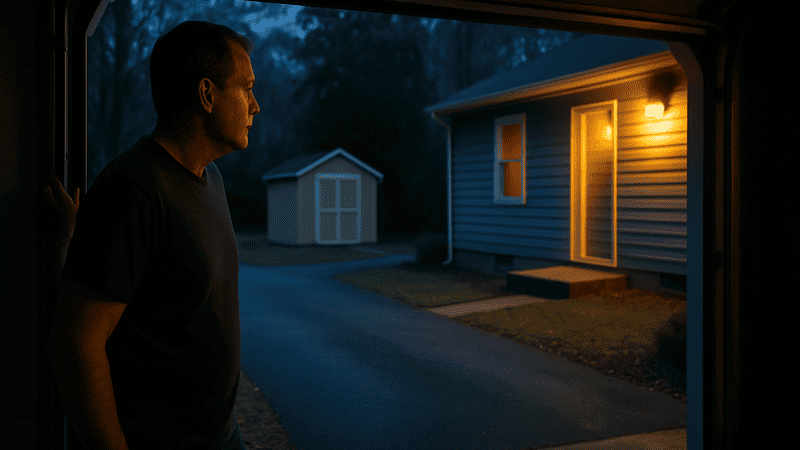
“`
Quick Answer
Castle Doctrine protection is not one blanket rule that covers your entire property — it changes depending on which structure you’re standing in and how enclosed that space is. Most states extend the strongest protection to your home itself, partial protection to attached structures like garages, and the weakest or most conditional protection to open areas like driveways and detached sheds. The line isn’t the property fence — it’s the structure.
Most homeowners assume Castle Doctrine is a single switch: you’re on your property, so you’re covered. That assumption is wrong, and it’s wrong in a way that surprises people at the worst possible moment. The real map of protection is a lot stranger than most people expect — a locked shed twenty feet from your back door can fall into a completely different legal category than the garage attached to your kitchen. Nobody explains it this way, so let’s actually draw the lines.
This post breaks down how Castle Doctrine typically treats attached garages, detached sheds, and driveways — three spaces almost every property has, and three spaces that are treated almost nothing alike under the law. We’ll also cover where non-lethal preparedness fits into each zone, because the legal question and the practical safety question are not the same question.
Does Castle Doctrine cover an attached garage?
In most states, yes — an attached garage is treated as an extension of the dwelling because it shares a wall or entry point with the home itself. This is the part of the property map that surprises people the least, but it’s still worth stating plainly: if your garage is physically connected to your house, most Castle Doctrine statutes fold it into the same protection as your living room.
Here’s the angle nobody points out, though. “Attached” doesn’t always mean what people think it means. A garage connected by a breezeway, a carport with a shared roofline but no walls, or a converted structure with a separate entrance can blur the definition depending on your state’s statute language. The law cares about structural connection and reasonable expectation of privacy — not just physical proximity.
This is exactly the kind of space where non-lethal preparedness makes sense precisely because the legal ground is solid. A pepper spray with the right range for close quarters works well in a garage-sized space, where distance is short and control matters more than reach. It’s worth thinking about proximity before you think about product — a garage is a box, not a yard.
What about a detached shed — is that covered the same way?
Usually not to the same degree, and this is where most homeowners get it wrong. A detached shed, even one on your own property, is often treated as a separate structure under the law — closer to a storage unit than a bedroom. Some states extend “curtilage” protection to structures near the home; others draw a much tighter circle around the dwelling itself.
The unexpected part: distance from the house isn’t always the deciding factor. What matters more, in many statutes, is whether the structure is used as a place people occasionally sleep, whether it’s enclosed, and whether it’s locked. A shed with a cot and a deadbolt can read very differently under the law than an open-air tool shed with no door at all.
This is a genuinely strange corner of property law, and it’s exactly why sheds deserve their own safety plan instead of borrowing the house’s plan. A disguised stun gun built for daily carry makes more practical sense out here than a stationary alarm system, since sheds are often the least monitored, least lit part of a property — the place someone checks last, not first.
Is a driveway protected under Castle Doctrine?
This is the part of the property map most people get completely backwards. A driveway is often the least protected part of your entire property under Castle Doctrine — even though it feels like the most “yours” because your car sits there every night. Driveways are open, publicly visible, and frequently classified as shared or transitional space rather than private dwelling space.
Here’s the twist that changes how people should actually think about their property: the driveway is often legally closer to the sidewalk than it is to the house. Delivery drivers, neighbors, and even strangers have an implied right to walk up a driveway to reach your front door. That implied right doesn’t disappear just because you own the concrete.
This is precisely why the driveway is the zone where awareness tools outperform confrontation tools. A personal alarm creates noise and draws attention in a space designed to be seen — which is the opposite strategy of a garage or shed, where the goal is often to de-escalate in a tight space with no witnesses. Different zone, different tool, different legal footing. That’s the whole point most guides miss.
Why does the type of structure matter more than the property line?
Because Castle Doctrine was never built around property lines — it was built around the concept of a dwelling. The fence around your yard tells you where your land ends. It tells you almost nothing about where your legal protection changes. That distinction is the single most misunderstood part of Castle Doctrine, and it’s the reason so many homeowners assume more protection than they actually have.
The unexpected reality: a locked, walled, occupied structure gets you the strongest protection. An open, unwalled, or rarely-used structure gets you the weakest. Your driveway, your carport, your open patio — these read as “yard,” not “dwelling,” in the eyes of most statutes, regardless of how close they sit to your front door.
This is why smart property owners stop thinking in terms of “my land” and start thinking in terms of zones. Each zone has its own legal footing and its own practical safety needs — which is also why product choice should follow the zone, not the property as a whole.
How should you actually prepare each zone differently?
Match the tool to the zone, not the zone to the tool — that’s the innovation most people miss. A garage calls for something effective at close range, since garages are enclosed and confrontations there tend to happen fast and close. A shed calls for something concealable and always on you, since sheds are visited infrequently and often alone. A driveway calls for something loud and attention-drawing, since driveways are open and visibility works in your favor.
Consider building out each zone with intention:
- Garage: a compact stun gun sized for close-quarters use, stored somewhere accessible but secure
- Shed: a small, disguised device you carry with you rather than store on-site
- Driveway: a high-decibel personal alarm plus basic lighting, since deterrence beats confrontation in open, visible space
None of this replaces knowing your state’s specific statute language. But it does mean you’re not treating three legally different spaces as if they were one — which is the mistake almost every generic self-defense guide makes.
Frequently Asked Questions About Castle Doctrine and Property Zones
Does Castle Doctrine cover my entire property, including the yard?
No. Most states limit strong Castle Doctrine protection to the dwelling itself and directly attached structures. Open yard space, driveways, and detached structures often fall under different — usually weaker — legal standards. Your property line and your legal protection line are rarely the same line.
Is my attached garage treated the same as my house under Castle Doctrine?
In most states, yes, because it’s structurally connected and shares access with the home. However, the specific wording of “attached” varies by state, and structures like breezeways or shared-roof carports can complicate that classification. Check your state’s exact statute language for certainty.
Does a detached shed get the same protection as my home?
Usually not. Detached structures are often treated separately from the main dwelling unless they’re enclosed, locked, and occasionally used for sleeping. Many states apply a narrower protection standard to detached buildings compared to the home itself.
Why is my driveway less protected than I expected?
Driveways are often legally treated as semi-public access routes, since delivery drivers, mail carriers, and visitors have an implied right to use them to reach your door. This makes driveways one of the least protected zones on a residential property under most Castle Doctrine statutes.
What determines whether a structure counts as part of my “dwelling”?
Most states look at physical connection to the home, whether the space is enclosed, whether it’s locked, and whether it’s used for sleeping or daily living. A structure meeting more of these criteria is more likely to receive dwelling-level protection.
Should I use the same self-defense tool for my garage, shed, and driveway?
No. Each zone has different visibility, distance, and risk factors. Enclosed spaces like garages favor close-range tools, rarely visited spaces like sheds favor concealable daily-carry options, and open spaces like driveways favor loud, attention-drawing deterrents like personal alarms.
Does locking a shed change its legal status?
In many states, yes — a locked, enclosed structure is treated more seriously under the law than an open or unsecured one. Locking mechanisms and enclosure are two of the factors courts consider when determining whether a structure functions as part of the dwelling.
Where can I find my state’s exact Castle Doctrine rules for outbuildings and driveways?
Your state’s official legislative website will have the exact statute language, and a local attorney can explain how courts in your area have interpreted it. This post explains general patterns across states, not specific legal advice for your property.
The Bottom Line
The fence around your property was never the legal boundary that mattered — the walls were. Once you see your property as a set of distinct zones instead of one undivided space, the right preparation for each one becomes obvious instead of guesswork. Garage, shed, and driveway were never meant to be treated the same, legally or practically — and now you know why.