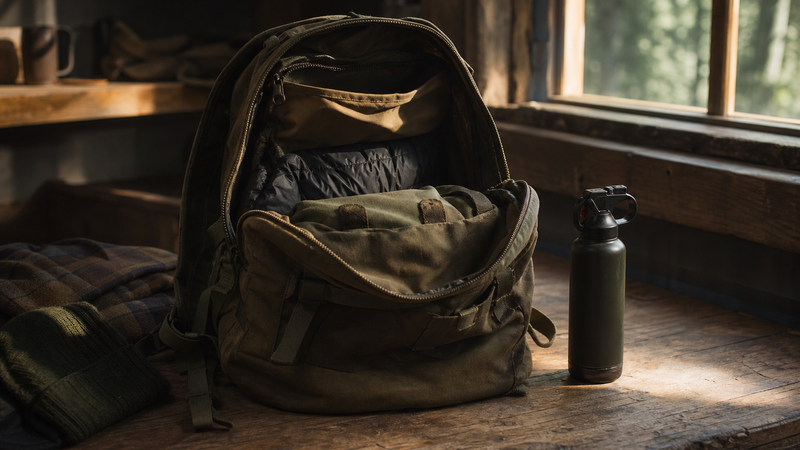
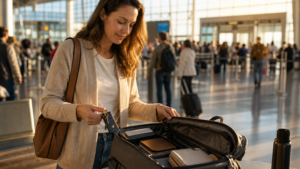
Bear spray cannot be taken on an airplane — not in your carry-on, and not in your checked luggage. The TSA prohibits it on all commercial flights because it contains compressed gas and an irritant concentration high enough to classify it as a hazardous material under federal transportation rules. If you’re planning to travel with it, plan differently.
Most people assume the rules around aerosols on airplanes are straightforward. They’re not. The line between what’s allowed and what’s banned is thinner than most travelers realize — and bear spray sits on the wrong side of it, even when your intentions are completely legitimate. There’s more to this story than a simple yes or no.
Why is bear spray treated differently than regular pepper spray on airplanes?
This is where things get quietly complicated. Bear spray and pepper spray both use capsaicin-based formulas. They both spray. They both cause intense irritation. But in the eyes of the TSA and the Department of Transportation, they are not the same product — and the distinction matters more than most travelers realize.
Bear spray is specifically formulated to deploy at high volume, high velocity, and at a concentration that creates a wide deterrent cloud. EPA regulations actually mandate a minimum capsaicin concentration for bear spray to be effective against large predators. That concentration — typically 1% to 2% — is higher than what you’ll find in most personal defense sprays. The canister is also significantly larger, usually holding 7 to 9 ounces of pressurized gas.
That combination — high-pressure canister, high volume, high irritant concentration — is what puts it in a different regulatory category. The DOT classifies bear spray as a hazardous material. That classification is what bars it from passenger aircraft entirely. It doesn’t matter why you’re carrying it. The chemistry is the problem, not the intent.
Personal defense sprays, on the other hand, occupy a smaller, more precisely defined space. A small canister — under 4 ounces, with a concentration at or below 2% capsaicin, equipped with a safety mechanism — may be allowed in checked luggage under TSA rules. One canister per passenger. Carry-on is still prohibited. The distinction is real, and knowing it before you pack could save you from a confiscation at the security line.
What does the TSA actually say about pepper spray in checked bags?
The TSA permits one small canister of mace or pepper spray in checked baggage under specific conditions. The canister must be 4 fluid ounces or less. It must be equipped with a safety mechanism to prevent accidental discharge. And it must contain no more than 2% by mass of tear gas — which, for practical purposes, refers to the CS or CN compounds sometimes combined with OC (oleoresin capsicum) in defense sprays.
Those rules apply to personal defense sprays only. Bear spray does not qualify. Its volume alone disqualifies it — and its EPA-required concentration often exceeds the 2% threshold. No safety cap changes that classification.
What’s worth noting: the rules can and do change. Airlines may impose stricter standards than the TSA baseline. A carrier that permits pepper spray in checked luggage according to federal guidelines may still prohibit it under their own policy. Checking your airline’s specific rules before you fly isn’t optional — it’s the only way to know for certain what will and won’t be waiting for you on the other side of security.
For travelers who want to know more about what self-defense products are and aren’t permitted on commercial flights, I’ve written a fuller breakdown here: Can you carry non-lethal self-defense products on an airplane?
Can you ship bear spray to your destination instead of flying with it?
Some travelers try to solve the problem by shipping bear spray ahead. It’s worth understanding the limits of that approach before you make assumptions.
The USPS prohibits mailing aerosol products that are considered hazardous materials — and bear spray qualifies. Private carriers like UPS and FedEx may allow it under certain conditions, but it typically requires ground shipping only, proper hazardous materials labeling, and compliance with carrier-specific restrictions. Overnight or air shipping is generally not permitted.
If you’re heading into genuine bear country, purchasing bear spray at your destination is often the most practical solution. Outdoor supply stores in national park gateway communities stock it. Rental is sometimes available at park visitor centers. Buying or renting on-site keeps you compliant and avoids the logistics problem entirely.
The bear spray question, in that sense, solves itself — if you accept that the solution exists at the other end of the trip, not the beginning of it.
What self-defense options can you legally travel with on an airplane?
This is the question that matters most for travelers who simply want to stay protected on the road. Bear spray is off the table. What remains?
A small defense spray — under 4 ounces, with a safety mechanism — in your checked luggage is one option. A 2 oz pepper spray is compact enough to fit TSA guidelines and effective enough to matter in a real situation. It’s not going to stop a grizzly bear. It will stop a human threat at close range. That’s what most travelers actually need.
Personal alarms are another option, and one most people overlook. A clip-on personal alarm is allowed in both carry-on and checked luggage. It doesn’t expire. It requires no concentration threshold. It emits 120 to 130 decibels — enough to draw immediate attention in a hotel corridor, a parking garage, or a crowded transit station. For travelers who don’t want to navigate spray regulations at all, an alarm is the cleanest solution.
Stun guns and TASERs occupy a separate category. They are prohibited in carry-on bags. In checked luggage, they may be permitted depending on the airline and destination — but the rules vary enough that checking first is essential. Some states also restrict possession entirely, which is a layer of complexity that applies before you even think about the flight.
The honest answer for most travelers: a compact defense spray in checked luggage and a personal alarm in your carry-on gets you covered without any regulatory gray area.
What happens if TSA finds bear spray in your bag at the checkpoint?
They confiscate it. That’s the short version.
The longer version is that the consequences depend on how it’s found and what the screener determines about intent. In most cases, a traveler who unknowingly packed bear spray will simply have it removed and be allowed to proceed. You may be offered the option to return it to your vehicle, check it with a ticketing agent (who will refuse it), mail it home, or leave it behind.
In cases where the item is determined to be a deliberate attempt to bring a prohibited item past security, the situation can escalate. TSA has the authority to refer matters to law enforcement. That outcome is rare for bear spray specifically — but it is not impossible, and it underscores why knowing the rules in advance is not a minor detail.
The canister itself, in most cases, is simply abandoned at the checkpoint. There is no reclaim process. A $45 to $60 canister becomes a sunk cost the moment the screener flags it.
Are there better everyday carry options for travel safety beyond aerosols?
There are — and some of them are worth understanding before your next trip, whether you’re flying or not. Defense sprays get most of the attention. But the full range of defense sprays available for self-defense is broader than most people realize, and some formats travel more conveniently than others.
A pepper spray with a flip-top safety is a good example — compact, secure against accidental discharge, and TSA-compatible when sized correctly for checked luggage. It takes up minimal space and requires no special storage.
For hotel stays and apartment rentals, a door stop alarm or a compact defense spray suited to smaller spaces adds another layer without adding bulk. Travel safety, done well, is layered. No single tool covers every scenario. The people who stay safest on the road are the ones who think it through before they pack — not after the flight is booked.
If you want a deeper look at how pepper spray performs in real-world locations — including parking garages and transit areas where you’re most exposed as a traveler — this post on pepper spray in a parking lot covers the nuances worth knowing.
Frequently Asked Questions About Bear Spray and Air Travel
Can I put bear spray in my checked luggage on a flight?
No. Bear spray is prohibited in both carry-on and checked luggage on commercial passenger flights. The TSA and the Department of Transportation classify it as a hazardous material due to its high-pressure canister, volume, and irritant concentration. No exceptions apply based on destination or intent. Your best option is to purchase or rent bear spray at your destination.
What’s the difference between bear spray and pepper spray for travel purposes?
Pepper spray formulated for personal defense may be allowed in checked luggage in a canister of 4 ounces or less, with a safety mechanism. Bear spray is specifically excluded — its EPA-required concentration and large canister volume place it in a different regulatory category. Personal defense sprays and bear sprays are not interchangeable for air travel purposes, even though both use capsaicin-based formulas.
Can I ship bear spray to my destination before I fly?
The USPS prohibits mailing bear spray because it’s classified as a hazardous aerosol. Private carriers may allow ground shipping with proper hazmat labeling, but air shipping is generally prohibited. In most cases, purchasing or renting bear spray at your destination — particularly near national parks — is the most practical and legally straightforward approach.
What self-defense items can I bring on an airplane?
A small pepper spray canister — 4 ounces or less, with a safety mechanism — may be allowed in checked luggage on most U.S. flights. Personal alarms are permitted in both carry-on and checked bags. Stun guns and TASERs may be permitted in checked luggage depending on the airline and destination — verify before flying. Nothing aerosol or electrical is allowed in carry-on bags.
Will TSA arrest me if they find bear spray in my bag?
In most cases, no. TSA typically confiscates the item and allows the traveler to proceed. If the screener determines the item was intentionally smuggled, they can refer the matter to law enforcement — but that outcome is uncommon for bear spray. The more likely result is losing the canister at the checkpoint with no way to reclaim it. Knowing the rules beforehand is the only reliable way to avoid it.
Is bear spray legal to own and carry in all U.S. states?
Bear spray is legal in most U.S. states for use in wilderness settings. However, some states restrict or prohibit its use for personal defense against human threats, and a few jurisdictions treat it the same as other defense sprays for regulatory purposes. State and local laws vary. It’s worth checking the rules for any state you’re traveling through or to before you purchase or carry it.
Can I carry a personal alarm on an airplane?
Yes. Personal alarms — including clip-on and keychain models — are permitted in both carry-on and checked luggage. They contain no aerosol, no pressurized gas, and no electrical discharge mechanism that would trigger TSA restrictions. For travelers who want a simple, regulation-free safety tool, a personal alarm is one of the cleanest options available.
Is there a pepper spray small enough to meet TSA carry-on rules?
No. Defense sprays of any size are prohibited in carry-on bags on commercial flights, regardless of canister size or formula. TSA rules allow a small pepper spray canister only in checked luggage, and only under the specific conditions noted above. There is no size of pepper spray that is approved for carry-on travel on commercial passenger aircraft.
Travel has a way of exposing the gaps in what we think we know about our own safety. Bear spray is one of those gaps — it looks like a simple answer to a simple problem until you’re standing at a security checkpoint learning otherwise. The rule isn’t arbitrary. The chemistry is genuinely different, and the regulations reflect that difference.
What I’d rather see you walk away with is a layered approach: a compact defense spray in your checked bag, a personal alarm clipped to whatever you’re carrying on, and a clear understanding of what’s allowed before you get to the airport. You can browse options across all three categories at Stun Guns. I don’t want you to need any of it. But I want you to have it if you do.