The best disguised camera to catch nursing home abuse is a clock camera or a photo frame camera with 1080p HD resolution, motion-activated recording, and night vision capability. These form factors blend naturally into elder care room environments, operate silently without drawing staff attention, and produce footage clear enough to serve as evidence. Battery-powered models with loop recording and Wi-Fi remote access offer the most complete documentation capability.
If your loved one lives in a care facility and something feels wrong, you are not being paranoid. You are paying attention. The decision to place a hidden camera in a nursing home room is not made lightly — it comes after sleepless nights, unanswered questions, and the quiet, unshakeable sense that the person you trust this facility to protect is not being treated the way you were promised. This post will help you choose the right camera with the same standard of care you bring to every other decision about your family member’s wellbeing.
What makes a hidden camera effective for nursing home monitoring?
Effectiveness in this setting is not about raw technology. It is about fit — how well the camera integrates into the room, how reliably it captures what matters, and how seamlessly it operates without your constant attention. A camera that requires daily battery swaps or produces grainy footage at 720p is not adequate for this purpose. You need something that performs without fail, because you may not know when you need that footage until after the fact.
Resolution matters first. A minimum of 1080p Full HD is the standard worth holding to. At that resolution, facial features are identifiable, actions are clear, and timestamps are legible. Footage captured at lower resolution may be challenged as inconclusive. This is not a place to economize. You can browse HD hidden cameras designed for discreet monitoring that meet this threshold without drawing attention to themselves.
Motion activation is the second non-negotiable. Continuous recording fills storage quickly and forces you to scrub hours of footage searching for incidents. A properly calibrated motion-activated camera records only when there is activity in the room — when a staff member enters, when someone approaches the bed, when movement occurs near your family member. This produces targeted, reviewable footage and extends battery or storage life significantly.
Night vision rounds out the core requirements. Many care facilities dim or cut room lights at night. Incidents do not follow daylight schedules. A camera without low-light capability is blind for half its potential operating window. Infrared night vision, particularly at ranges of 15 feet or more, captures clear footage in complete darkness without emitting visible light. See how this applies to elder care settings in our post on which hidden cameras work best in low light for elder care monitoring.
Which disguised camera forms work best inside a care facility room?
The form factor of the camera determines whether it survives scrutiny. A device that looks out of place will be noticed. A device that belongs in the room will not. These are the form factors that earn their place.
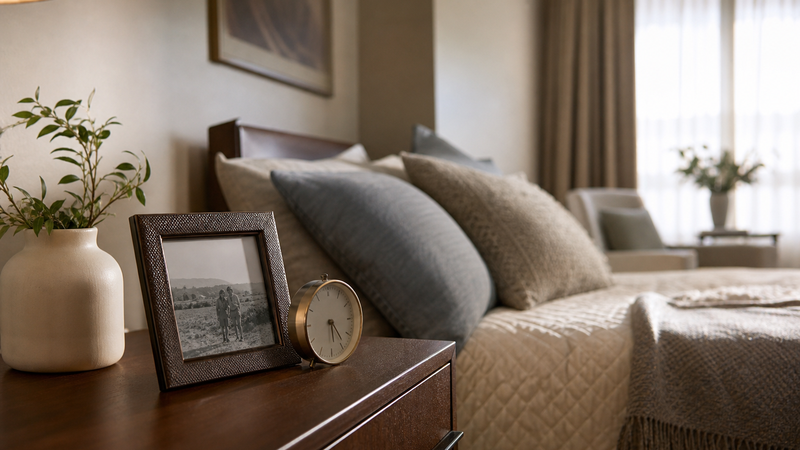
Clock cameras. A bedside or wall clock is among the most credible objects in any room. It belongs there. No one questions it. Clock cameras with built-in 1080p lenses, motion detection, and Wi-Fi connectivity are among the most capable disguised options available. The lens is centered naturally within the clock face, giving it an unobstructed line of sight to most of the room. They are easy to position, easy to power via AC adapter, and easy to check remotely if the model supports app connectivity.
Photo frame cameras. A framed family photograph on a dresser or nightstand is as natural as a clock. It carries emotional weight that makes it unlikely to be moved or questioned. Frames with concealed 1080p cameras and motion activation offer a wide-angle view of the room from a low, stable position. They also carry a layer of personal authenticity — if a staff member sees a frame with family photos, they are looking at a family’s presence in the room, not a surveillance device.
Hidden camera pens and small object cameras. For supplementary placement or for situations where you need to document something more specifically — a wheelchair, a hallway encounter, transport — a hidden camera pen can be positioned discreetly in a cup or on a surface. These are not primary monitoring solutions for a room, but they serve a targeted documentation role when needed.
Smoke detector cameras. In rooms where ceiling placement is accessible and appropriate, smoke detector-style cameras offer the widest field of view available. They cover the full room from above, which is often the most complete angle for capturing interactions near the bed. These require a bit more installation consideration but deliver superior coverage.
How important is Wi-Fi connectivity for nursing home camera monitoring?
Wi-Fi connectivity separates a capable camera from a truly useful one in this context. A camera that stores footage locally — on a microSD card — requires you to physically retrieve and review the card. That means regular visits to collect evidence, and it means you are always reviewing what already happened rather than monitoring in real time.
A Wi-Fi-enabled camera lets you check a live feed from your phone, receive motion-alert notifications, and review footage remotely as often as you choose. If a notification comes through at 2 a.m., you can open the app and see what triggered it without leaving your home. That capability is not a convenience — it is a meaningful difference in how quickly you can identify a problem and respond.
One practical consideration: nursing home rooms may have limited Wi-Fi access, or the facility’s network may not be accessible to personal devices. In those cases, some cameras operate on their own mobile hotspot, using a SIM card for connectivity independent of the facility’s infrastructure. This is worth evaluating before purchase if you are uncertain about the network environment in the room.
How long does a hidden camera need to record to document nursing home abuse?
Documentation of care facility abuse rarely captures a single dramatic event. More often, it is a pattern — repeated rough handling, consistent neglect, ongoing verbal treatment that crosses clear lines. That pattern takes time to establish on film. A camera that runs out of storage after four hours of recorded footage is not adequate for this purpose.
Loop recording is the feature that addresses this. A camera with loop recording on a 32GB or 64GB microSD card continuously overwrites the oldest footage with new footage, meaning the camera never stops recording due to a full card. You retain the most recent footage — often the most relevant — while the camera operates indefinitely. You can explore battery life considerations in depth in our post on which hidden cameras have the longest battery life for elder care.
For rooms where AC power is accessible — and in most nursing home rooms, it is — a hardwired or AC-adapter-powered camera eliminates battery concerns entirely. You plug it in, configure it once, and it runs. That is the most reliable operational posture for long-term monitoring.
What should you look for in image quality when using a hidden camera as evidence?
If the footage you collect is ever used in a formal complaint, an investigation, or legal proceedings, its evidentiary value depends on clarity. A camera that captures blurry silhouettes and indistinct movement does not establish much. A camera that captures faces, expressions, and actions in clear detail tells a different story.
Beyond resolution, look for wide-angle lens coverage — 120 degrees or broader — that captures the full room rather than a narrow slice of it. Look for cameras with adequate frame rates, at minimum 30 frames per second, which produce smooth footage rather than choppy, hard-to-interpret sequences. And look for built-in timestamp functionality. Date and time stamps embedded in the footage establish the timeline of events — which is often as important as the events themselves.
The hidden cameras with night vision that meet this standard perform in both lit and unlit conditions without requiring you to manage two separate devices for day and night coverage.
Is it legal to record inside a nursing home room?
This question deserves a direct answer, even though laws vary by state and I am not in a position to give legal advice for your specific situation. In general, most states permit recording in a nursing home room when the room’s occupant or their legal guardian consents to it. Some states have enacted specific “granny cam” laws that explicitly protect a resident’s right to use a monitoring device in their own room. A handful of states impose notification requirements.
Before placing a camera, look up your state’s specific statutes on electronic monitoring in care facilities. Your state’s long-term care ombudsman office is a reliable starting point. So is a brief consultation with an elder law attorney. The investment of thirty minutes of research or one phone call is worth it. Properly documented footage collected lawfully is far more useful than footage whose admissibility is in question.
Frequently Asked Questions About Disguised Cameras for Nursing Home Monitoring
What is the best camera disguise for a nursing home room?
A clock camera or photo frame camera is the most effective disguise for a nursing home room. Both objects are expected in that environment and attract no attention from staff. Clock cameras offer a natural center-mounted lens with good room coverage. Photo frame cameras sit naturally on a dresser or nightstand and are rarely questioned or moved. Both are available with 1080p resolution, motion detection, and night vision.
Does a hidden camera for elder care need night vision?
Yes. Many care facility incidents occur at night during low-staffing hours when room lights are off or dimmed. A camera without night vision is effectively blind during these hours. Infrared night vision with a range of 15 to 20 feet captures clear footage in complete darkness without emitting visible light that would alert staff to the camera’s presence. Night vision is not optional for serious monitoring.
Can I monitor a nursing home camera remotely from my phone?
Many hidden cameras with Wi-Fi connectivity support live viewing and motion-alert notifications through a companion smartphone app. This allows you to check the room in real time and receive alerts when motion is detected, without physically visiting the facility. Some cameras use a facility’s Wi-Fi network; others operate on an independent mobile data connection via SIM card, which may be preferable if the nursing home’s network is not accessible to personal devices.
How much storage does a nursing home monitoring camera need?
A camera with a 32GB or 64GB microSD card and loop recording capability is adequate for continuous monitoring. Loop recording automatically overwrites the oldest footage when the card is full, ensuring the camera never stops due to a full card. A 64GB card with motion-activated recording at 1080p can retain several days of triggered footage before overwriting. For long-term monitoring, AC power with a large-capacity loop-recording card is the most reliable configuration.
Will nursing home staff be able to detect a hidden camera?
A properly selected and placed hidden camera designed to look like a common room object — a clock, a photo frame, a small decorative item — is not detectable by casual observation. Staff who are not specifically looking for surveillance equipment will not identify it. Avoid cameras with visible indicator lights, audible sounds during recording, or unusual positioning that draws the eye. A well-chosen camera placed in a natural location should attract no more attention than any other personal item in the room.
Do I need to tell the nursing home I am recording?
This depends on your state’s laws. Some states require notification to the facility before placing a monitoring device; others do not. A growing number of states have enacted specific elder care monitoring statutes that define notification requirements and resident rights. Research your state’s specific laws or consult an elder law attorney before placement. The nursing home resident’s right to privacy in their own room is the legal foundation most of these statutes build on.
What resolution should a nursing home hidden camera have?
1080p Full HD is the minimum standard worth holding to for elder care monitoring. This resolution produces footage clear enough to identify individuals, capture specific actions, and display legible timestamps — all factors that matter if footage is reviewed by investigators, attorneys, or regulatory agencies. Lower-resolution cameras produce footage that may be dismissed as unclear or inconclusive. Higher resolution, such as 2K or 4K, offers additional clarity if available within your budget.
How do I know if something is wrong at my loved one’s nursing home?
Common warning signs include unexplained bruising or injuries, sudden behavioral changes in your family member, reluctance to speak in front of staff, unexplained weight loss, poor hygiene, and evasive answers from staff when you ask direct questions. If you observe any of these, document what you see, report your concerns to the facility’s administration and your state’s long-term care ombudsman, and consider placing a monitoring camera in the room to establish a record going forward.
Your family member chose this facility — or you chose it for them — because it represented a standard of care you believed in. When that standard appears to be failing, you are entitled to know. A properly selected hidden camera does not replace your visits, your advocacy, or your voice. It extends your presence into the hours when you cannot be there, and it gives you something a concern or a feeling cannot provide: documented evidence.
If you are ready to evaluate your options, start with our selection of HD hidden cameras built for discreet, reliable monitoring. Choose the form factor that fits the room. Choose the resolution and features that meet the standard this situation demands. Your loved one deserves that level of care in every decision you make on their behalf.