No-spin knife throwing is a technique where the knife travels to the target without rotating in the air, relying on a push-style release and consistent hand speed instead of distance-based spin counting. It’s the method most professional throwers use because it’s more forgiving, more accurate at varying distances, and far safer to learn than traditional rotational throwing. Anyone can learn the basics with a properly weighted throwing knife, a soft wood target, and about twenty minutes of dedicated practice a day.
What is no-spin knife throwing and why do people fall in love with it?
I still remember the first knife I ever threw that stuck clean, no wobble, no bounce, just a quiet thunk into the wood. That sound does something to a person. No-spin throwing is what makes that sound happen on purpose, every time, instead of by accident.
The technique works by holding the knife so it doesn’t rotate end over end during flight. Instead of relying on the blade tumbling a precise number of times before it hits — which changes completely depending on how far back you’re standing — the thrower uses a straight-line push motion. The knife travels point-first the entire way. Distance stops being the enemy. You can step back, step forward, throw from an awkward angle in the backyard, and the knife still lands the same way.
People get hooked on this because it feels like something you earn. It’s not luck. It’s not a trick. It’s hours of your own hands learning a rhythm. That’s the part that pulls people in — the quiet satisfaction of a skill that’s entirely yours.
How is no-spin throwing different from traditional spin throwing?
Traditional spin throwing requires the knife to complete a specific number of rotations — usually a half or full spin — before impact. That means your distance from the target has to be almost exact. Move six inches closer or farther, and the knife hits handle-first instead of point-first.
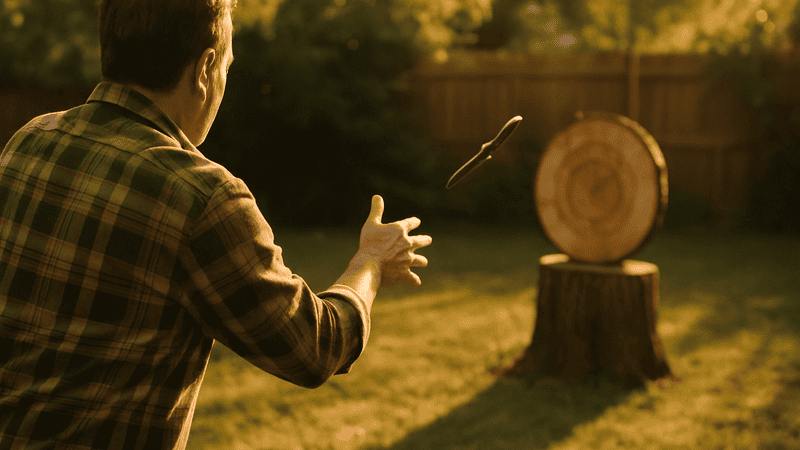
No-spin throwing removes that variable entirely. You hold the blade with your fingers extended along the flat of the steel, not gripped in a fist. The release is a straight push forward, like you’re pushing a door open, not a whip or a snap. The knife glides through the air point-forward without tumbling.
This is why professional throwers — the ones who perform at demonstrations, teach classes, or compete — almost always use the no-spin method for anything beyond short, fixed distances. It’s the technique that respects the fact that real life isn’t a measured range. Your backyard has trees, slopes, uneven ground. No-spin throwing adapts to that. Spin throwing doesn’t.
What kind of knife do I need to learn no-spin throwing?
You need a knife built specifically for throwing — not a folding pocket knife, not a kitchen knife, not something with a handle that flexes or a blade that’s too light to carry momentum. Throwing knives are typically solid steel from tip to butt, with no moving parts and balanced weight distribution.
If you’re weighing your options between different blade styles for everyday carry versus throwing, it helps to understand the mechanical differences first. Our comparison on butterfly knife vs folding knife designs breaks down why folding mechanisms — while great for carry — are the wrong tool entirely for throwing practice. A throwing knife needs to be one solid piece. No hinge, no lock, no risk of folding back on itself mid-flight.
Look for a knife between 8 and 12 inches, weighted slightly toward the blade or evenly balanced, depending on your grip preference. Beginners usually do best with a blade-heavy knife because it’s more forgiving of small grip errors. This is a personal thing — the knife that feels right in your hand is the one you’ll actually practice with, and that matters more than any spec sheet.
What’s the correct grip and stance for beginners?
Hold the knife flat against your palm with your fingers resting along the spine or the flat of the blade, thumb placed naturally on top. This is called a hammer grip when done with the handle, or a blade grip when you’re holding closer to the steel. For no-spin throwing, most people find more control gripping closer to the blade, since it shortens the lever and reduces unwanted rotation.
Stand with your non-throwing foot slightly forward, shoulders square to the target, knees soft. Bring the knife back past your ear, elbow leading, and drive forward in a straight line — like you’re reaching out to hand someone the knife rather than throwing it. The release happens naturally when your arm reaches full extension. You’re not snapping your wrist. You’re not adding spin on purpose. You’re just letting go at the right moment.
This part takes patience. I’ve watched grown adults get frustrated in the first ten minutes because their knife keeps cartwheeling into the dirt. That’s normal. Every single person who’s good at this now was bad at it first. The difference is they kept showing up.
How much distance and practice do I need before I start hitting the target?
Start at six to eight feet from your target. That’s close enough to build muscle memory without the discouragement of missing constantly, but far enough that you’re genuinely practicing the throw, not just dropping the knife into the wood.
Set aside fifteen to twenty minutes a day, three or four days a week. Consistency matters more than long sessions. Your hand needs to learn the exact feeling of a clean release — that’s a physical memory, not something you can think your way into. Most people start sticking the blade reliably within two to three weeks of regular practice at short range. Extending your distance comes after that foundation is solid, not before.
Use a proper target — untreated softwood like pine, mounted securely, away from anything you care about. A tree stump works well. So does a purpose-built end-grain target board. Never throw at something that can splinter dangerously or ricochet. And always throw somewhere private, away from foot traffic, where a missed throw lands somewhere safe.
Is knife throwing something I should learn for self-defense?
No — and I want to be honest with you about that, because I care more about your safety than about selling you something. Knife throwing is a discipline, a hobby, a skill that builds focus and confidence. It is not a self-defense tactic. Throwing your only knife away from your body in a real confrontation leaves you unarmed and leaves your attacker with a weapon on the ground.
If personal protection is what’s actually on your mind, that’s a different conversation, and it’s one I take seriously. Tools like pepper spray are built and tested specifically for defensive situations, not recreation. If you’re already carrying something for protection, it’s worth knowing how to use it correctly — our guide on how to use pepper spray correctly covers six things most people never practice, and it could matter far more than any throwing technique ever will. If you’re active and thinking about carrying while you run, we’ve also covered whether it’s safe to run with pepper spray and what to know before you do.
Knife throwing feeds something in us — focus, discipline, the joy of a physical skill done well. Protection feeds something else entirely — peace of mind. Both matter. They just don’t belong to the same part of your life.
Frequently Asked Questions About No-Spin Knife Throwing
Can I use a regular pocket knife for no-spin throwing?
No. Folding knives have hinges and locks that can fail or fold under the force of a throw, creating a real injury risk. You need a solid, one-piece throwing knife designed without moving parts. If you’re deciding between knife types for other purposes, our comparison of butterfly and folding knives explains the mechanical differences in more detail.
How far away should beginners stand from the target?
Start at six to eight feet. This distance is close enough to build accurate muscle memory quickly, while still requiring a genuine throw rather than a toss. Once you’re consistently sticking the blade at this range, gradually increase distance in small increments as your form solidifies.
Why does my knife keep spinning even though I’m trying the no-spin method?
This almost always comes down to wrist snap. The no-spin technique requires a straight push-release with a stiff wrist, not a flick. If your wrist bends forward at release, you’re adding rotation without meaning to. Slow the throw down and focus on a smooth, level follow-through.
Is no-spin throwing harder to learn than spin throwing?
It takes a bit more patience upfront, but it pays off faster in real practice. Spin throwing requires memorizing exact distances for each rotation count. No-spin throwing is more forgiving once you learn the grip and release, which is why most people find it more rewarding long-term.
What’s the safest target material to use at home?
Untreated softwood, like pine or poplar, mounted securely on a stump or stand, works best. Avoid hardwoods, which can cause dangerous bounce-back, and avoid anything with knots or metal fasteners. Always throw in a private area with clear space behind and around the target.
Should I practice knife throwing for self-defense purposes?
No. Throwing a knife in a real confrontation means giving up your only weapon and disarming yourself. Knife throwing is a recreational and focus-building skill, not a defensive tactic. For personal protection, tools designed and tested specifically for defensive use are a far better fit.
How long does it take to get good at no-spin throwing?
Most beginners see reliable sticks at short range within two to three weeks of consistent practice — about fifteen to twenty minutes, three to four times a week. Real proficiency, the kind where you can vary distance and still stick clean, takes a few months of steady, patient repetition.
What weight and length knife should a beginner buy?
Look for a solid, one-piece knife between 8 and 12 inches, with even balance or a slight blade-heavy design. Beginners generally find blade-heavy knives more forgiving of small grip mistakes. The right knife is the one that feels stable and natural in your hand during a slow practice throw.
There’s something quietly good about learning to do one thing with your hands until it becomes second nature. No-spin throwing gave me that, and it’s given a lot of people I’ve taught the same thing — a place to slow down, focus, and get better at something real. Take your time with it. Respect the tool, respect the space you’re throwing in, and let the skill build the way it’s supposed to: one throw at a time.