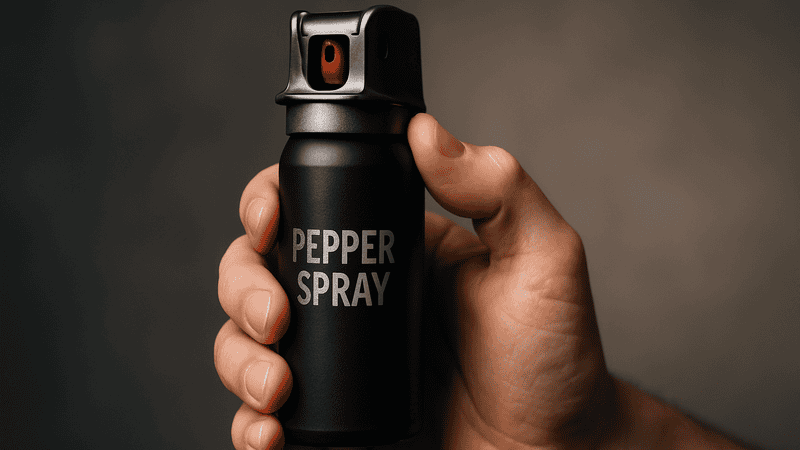
Pepper spray range depends entirely on the delivery pattern. Stream sprays reach the farthest, typically 10 to 20 feet, with tight accuracy in wind or outdoor conditions. Cone and fog patterns cover a wider area but usually top out around 8 to 12 feet. Gel formulas travel a similar distance to stream but with less blowback risk. Knowing which pattern matches your situation is the difference between a spray that works and one that simply feels like protection.
What determines how far a pepper spray actually reaches?
Range comes down to three things: the delivery pattern, the canister pressure, and the formula’s viscosity. A well-engineered stream pattern uses a narrow, pressurized jet that cuts through the air with minimal dispersion, which is why it consistently outperforms other patterns in distance. Fog and cone patterns trade distance for coverage, spreading the formula wider so precision matters less.
This isn’t a minor technical detail. It’s the entire reason serious buyers research spray patterns before they buy, rather than grabbing whatever’s on the shelf. A canister that maxes out at 6 feet is a different tool than one built for 18 feet, and treating them the same is how people end up under-equipped in a moment that doesn’t offer a second chance.
How far does a stream pepper spray actually reach?
Stream patterns typically reach 10 to 20 feet, making them the longest-range option on the market. The formula exits as a concentrated liquid jet rather than a mist, which means wind has little effect on where it lands. This is the pattern most often chosen by people who want distance and control over coverage.
Stream is the standard choice for runners who need to respond to a threat without slowing their pace, since accuracy at a distance matters more than blanket coverage. It’s also the preferred option for anyone carrying pepper spray in a vehicle, where a precise stream through a cracked window avoids spraying the interior of the car.
Brands like Pepper Shot and Mace both manufacture well-regarded stream formulas that prioritize this kind of long-range precision, and they remain popular among buyers who’ve done the comparison shopping.
How far does a fog or cone pepper spray reach?
Fog and cone patterns generally reach 8 to 12 feet, shorter than stream, but they compensate with width. A fog pattern disperses into a wide cloud, which increases the odds of contact even if aim isn’t perfect. Cone sits between stream and fog, offering a moderate spread with slightly better range than fog alone.
This tradeoff matters most indoors. A homeowner facing an intruder in a hallway benefits more from coverage than from a laser-precise stream that requires perfect aim under stress. That’s why fog and cone formulas are frequently recommended for home defense situations, where the threat may be moving, close, and unpredictable.
The downside is real and worth understanding before you buy: fog patterns carry a higher risk of blowback in windy or enclosed spaces, which is a serious consideration for anyone weighing options for outdoor use.
How far does gel pepper spray travel compared to stream?
Gel pepper spray travels a distance comparable to stream, often 10 to 18 feet, while sticking to the target on contact rather than misting into the air. This is a meaningful upgrade for anyone concerned about cross-contamination or self-exposure in tight quarters.
Gel’s thicker consistency means it doesn’t drift in wind and won’t rebound off walls or nearby surfaces the way a fog spray can. It’s a refined choice for people who want the reach of a stream with a lower margin for user error. Wildfire and SMART both offer gel formulations built specifically around this advantage, and they’ve become the preference among buyers who understand the tradeoffs between formulas rather than choosing on price alone.
For elderly users who may have less confidence in fine motor control under stress, gel’s forgiving nature and reliable distance make it one of the more sensible options available.
Does canister size affect the range of a pepper spray?
Canister size affects duration and number of bursts far more than it affects range. A small keychain canister and a larger belt-clip canister using the same formula and nozzle design will typically reach a similar distance. What changes is how many one-second bursts the canister can deliver before it’s empty.
This is where buyers who’ve done their homework separate themselves from those who haven’t. A compact canister might offer five to six bursts, while a larger unit built for professional use can offer significantly more. Security professionals, who may need to manage repeated or prolonged encounters, generally choose larger canisters for this reason, not because size adds distance, but because it adds staying power.
How does wind or weather affect pepper spray range?
Wind reduces the effective range of fog and cone patterns significantly, while stream and gel formulas remain largely unaffected. A crosswind can carry a fine mist several feet off course, which is a critical detail for anyone who expects to use pepper spray outdoors.
This is precisely why serious buyers don’t choose a spray pattern based on marketing alone. The right pattern depends on where you’ll realistically use it. Outdoor, open-air scenarios call for stream or gel. Indoor, close-quarters scenarios can accommodate fog or cone without the same wind-related risk.
Cold weather can also slightly reduce output pressure in some formulas, which is worth factoring in if you live somewhere with real winters and store your canister in a car or bag exposed to the elements.
How much distance do you actually need for real-world self-defense?
Most self-defense situations happen inside 10 feet, which means any well-chosen pepper spray pattern will cover the realistic distance involved. The value of a longer-range stream isn’t that you’ll need to spray someone from 20 feet away; it’s the margin of safety it gives you to respond before a threat closes distance entirely.
This is the detail that separates a thoughtful purchase from a rushed one. Buyers who understand range don’t just ask “does this work?” They ask “does this match how and where I’ll actually carry it?” That question is worth answering honestly before you buy, and it’s covered in more depth in our guide on how to use pepper spray correctly, including the practice habits most owners skip entirely.
Frequently Asked Questions About Pepper Spray Range
What is the average range of pepper spray?
Most pepper sprays reach between 8 and 20 feet, depending on the spray pattern. Stream and gel formulas reach the farthest, often 10 to 20 feet, while fog and cone patterns typically cover 8 to 12 feet with wider dispersion. The right range depends on your setting and how much precision versus coverage you need.
Which pepper spray pattern has the longest range?
Stream patterns consistently offer the longest range, often reaching 15 to 20 feet in quality formulas. The concentrated jet resists wind interference and allows for precise targeting at a distance, which is why it’s favored for outdoor use and vehicle defense scenarios.
Is gel pepper spray better than stream for range?
Gel and stream offer comparable range, typically within a foot or two of each other. Gel’s advantage isn’t extra distance — it’s reduced blowback risk, since the thicker formula sticks to the target rather than drifting through the air like a fine mist can.
Does a bigger canister mean pepper spray sprays farther?
No. Canister size primarily affects how many bursts you get, not how far each burst travels. Range is determined by nozzle design, formula viscosity, and internal pressure, not the overall size of the container.
Does wind reduce pepper spray’s effective range?
Yes, significantly for fog and cone patterns. A crosswind can push a fine mist off target by several feet. Stream and gel formulas are far more resistant to wind interference because they travel as a concentrated jet rather than an airborne cloud.
What range is best for home defense pepper spray?
Fog or cone patterns in the 8 to 12 foot range are often preferred for home defense, since indoor encounters happen at close quarters and wider coverage improves the odds of contact even under stress, when precise aim can be difficult.
Can cold weather reduce how far pepper spray reaches?
Cold temperatures can slightly reduce output pressure in some formulas, marginally affecting range. If you store pepper spray in a car or outdoor bag during winter months, check the manufacturer’s temperature guidance to ensure reliable performance.
How do I know which spray pattern is right for me?
Match the pattern to your environment. Choose stream or gel for outdoor use, vehicles, or situations requiring precision at distance. Choose fog or cone for indoor, close-quarters scenarios where wider coverage matters more than maximum range.
Choosing the right pepper spray isn’t about buying the biggest canister or the flashiest label. It’s about understanding exactly what you’re carrying and why. Buyers who take the time to learn the difference between stream, gel, cone, and fog make a more informed decision than those who don’t, and that decision matters far more in the moment it counts. Browse our full selection of pepper spray formulas and patterns to find the one built for how you actually live your day.