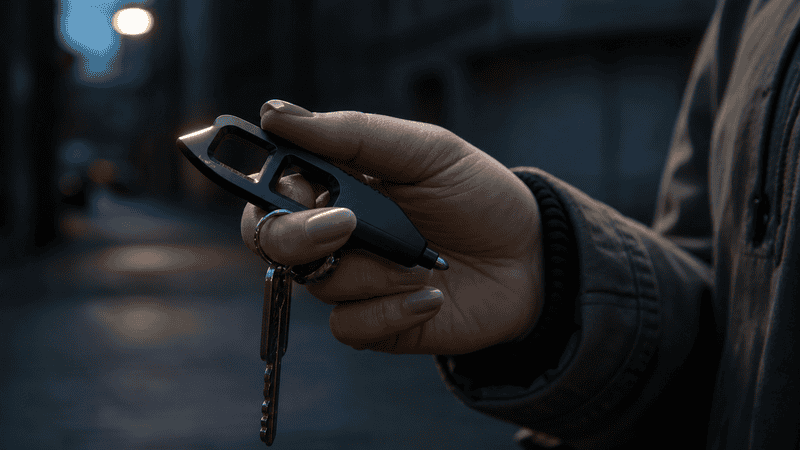
The best self defense keychain for women is one that combines a reliable impact or deterrent tool — such as a kubotan, cat-ear knuckle, or pointed striking device — with something she will actually carry every day. For most women, that means something small enough to clip to keys, discreet enough not to draw attention, and simple enough to use without training under pressure. The keychain category is broader and more capable than most people realize.
Most people searching this topic expect a quick product recommendation. What they don’t expect is how much is hidden in plain sight within this category — tools designed to look like one thing and function as something else entirely. That gap between appearance and capability is exactly what makes the right keychain such a quietly effective choice. I’ve seen people overlook these tools completely, assuming they’re novelty items. That’s a mistake I’d rather you not make.
What makes a self defense keychain different from a regular keychain accessory?
The difference isn’t obvious from the outside — and that’s deliberate. A well-designed self defense keychain is built around a principle that most casual observers don’t register: concentrated force applied to a small surface area creates disproportionate effect. That’s the physics behind every kubotan, every pointed striking tool, and every knuckle-style grip device in this category.
A standard keychain gives you something to hold your keys. A self defense keychain gives you a way to redirect the energy in your arm and hand into a focused point of contact. The difference between a palm strike and the same strike delivered through a hardened polymer tip is significant — not because you become stronger, but because the force doesn’t dissipate across a broad surface. It concentrates. That’s the quiet secret the tool carries without announcing itself.
Beyond impact, some keychain tools serve a deterrent function. Certain designs — particularly cat-ear or multi-point configurations — are recognizable enough to signal awareness without being overtly aggressive. Others are completely neutral in appearance, which carries its own kind of advantage: the element of surprise belongs to the person who knows what they’re holding.
What are the main types of self defense keychains available for women?
The category looks simple from the outside. It isn’t. There are at least four distinct tool types that fall under “self defense keychain,” and each one works through a different mechanism. Knowing the difference matters — not just for choosing the right one, but for understanding what you’re committing to carry.
Kubotan-style rods. These are cylindrical striking tools, typically 5–6 inches long, designed to be gripped in the fist with the end protruding. They extend the reach of a strike and concentrate force. They’re among the oldest tools in this category and remain effective precisely because they’re so simple. No moving parts. Nothing to activate. Nothing to forget under stress.
Cat-ear or pointed knuckle tools. These fit over the fingers and present one or more hardened points. They look distinctive — some women find that visibility a deterrent in itself. A pointed keychain self defense tool in this style is gripped before the hand closes, so it requires no fine motor activation in the moment. That matters more than most people account for.
Multi-function keychain sets. Some of the most interesting tools in this category combine multiple functions — a striking surface, a glass-breaker tip, and sometimes a blade element or alarm attachment — in a single compact package. A self defense keychain set gives a woman options she can configure based on where she’s going and what she needs. That flexibility is worth understanding before you assume one tool does everything.
Lightweight polymer designs. Not every woman wants to carry something heavy or conspicuous. A lightweight self defense keychain made from aircraft-grade polymer can be just as structurally sound as a metal tool — and far more comfortable to carry daily. Consistency of carry is what actually determines whether a tool is useful.
How do you know if a self defense keychain will actually work under pressure?
This is the question most guides avoid. They’ll tell you about materials and dimensions. They rarely tell you what actually happens when stress floods the body and fine motor skills degrade. The answer to this question isn’t really about the tool — it’s about the tool’s design relative to how humans perform under adrenaline.
Under real stress, your grip tightens before conscious thought kicks in. That’s not a weakness — it’s physiology. The tools that work with that response are the ones that require grip rather than manipulation. A kubotan or cat-ear tool that’s already in your hand provides immediate utility. A tool that requires you to flip open a blade, disengage a safety, or thumb a button introduces a step you may not complete.
The other variable most guides skip: familiarity. A tool you’ve never held before — one still in its packaging on the day you need it — is not a prepared tool. Whatever you carry, hold it. Practice the grip. Walk with it clipped to your keys for a week before you need to know whether you’ll reach for it. The tool doesn’t do the preparing. You do. That’s the part that doesn’t appear in any product description.
Are self defense keychains legal for women to carry in all states?
This is where I have to be direct with you: the legality of specific self defense tools varies by state, and in some cases by city or county. I’m not an attorney, and nothing here is legal advice. What I can tell you is that the keychain category exists in a middle space that many people don’t realize is regulated at all.
Certain pointed tools, knuckle designs, and even some striking tools fall under restrictions in specific jurisdictions — restrictions that apply regardless of intent. Before you purchase any tool in this category, look up your state’s self-defense tool laws. That search takes about ten minutes. It’s worth doing. Carrying something you don’t know is restricted doesn’t serve you.
If you’re uncertain about specific tools and want a non-lethal alternative that typically carries fewer legal complications in most states, personal alarms and certain non-lethal self defense options are worth considering alongside keychains. The goal is preparedness — not a tool you can’t legally carry where you live.
Should a self defense keychain replace pepper spray or a stun gun?
No — and understanding why matters. A keychain tool is a contact-range device. It requires you to be close to a threat, which means the situation has already escalated. Pepper spray and stun devices work at distance, which means they can potentially stop a threat before physical contact occurs. That distance advantage is real and significant.
The honest picture of preparedness isn’t one tool. It’s layered. Situational awareness is the first layer — and if you haven’t read about why situational awareness is the first line of defense, that post is worth your time before any product decision you make. A keychain tool is a last-resort, close-range option. Knowing that changes how you think about where it fits in your overall approach.
That said, there are situations where a keychain tool is uniquely appropriate — environments where carrying a visible deterrent device isn’t practical, or where a woman simply wants something that’s always on her keys and requires no separate bag or holster. In those cases, the keychain is not a compromise. It’s the right tool for the context. If you want to see how these tools compare against other options, the breakdown in the most effective self defense weapons for women gives you a ranked perspective worth considering.
What should you look for when choosing a self defense keychain?
Strip away the marketing and five things remain. These are the variables that actually determine whether a tool serves you.
Grip geometry. Does it fit your hand? A tool that shifts or rolls when you grip it under pressure is a liability. Hold it before you buy if possible — or at minimum, read reviews that describe how the grip performs rather than how it looks.
Material durability. Aircraft-grade aluminum and reinforced polymer are the standards worth trusting. Zinc alloy is common and acceptable for most scenarios. Avoid anything described as “decorative” — that word is telling you something.
Weight and clip security. A keychain self defense tool that falls off your keys, gets left behind because it’s too heavy, or pulls uncomfortably on a bag strap won’t be with you when you need it. The best tool is the one you actually have.
Activation simplicity. As mentioned above, anything requiring a button, release, or flip under stress introduces risk. Prioritize designs that work the moment they’re in your hand.
Fit with your lifestyle. A woman who commutes on public transit has different carry considerations than one who works in an office, drives everywhere, or spends time on college campuses. The tool should fit the context you’re actually in — not the context you imagine or worry about abstractly.
Frequently Asked Questions About Self Defense Keychains for Women
What is the most effective type of self defense keychain for women with no training?
For women with no formal self-defense training, the most effective keychain tools are those that require the least motor skill to deploy. Kubotan-style rods and cat-ear knuckle tools are ideal — they work as soon as they’re gripped and require no activation steps. Choose a design with a secure, non-slip grip and practice holding it correctly before you need it. Simplicity under stress is the real standard of effectiveness.
Can a self defense keychain actually stop an attacker?
A keychain tool can create enough pain, distraction, or hesitation to allow escape — which is the realistic goal. It isn’t designed to incapacitate. Striking pressure points, the nose, the throat, or the back of the hand with a hardened tip can interrupt an attack long enough to create distance. That window of opportunity is what you’re creating, not a decisive takedown. Escape is the objective. The tool supports that goal.
Are cat-ear self defense keychains legal?
Cat-ear keychains are legal in many U.S. states but restricted or prohibited in others — including California, where they may be classified as brass knuckles. Laws vary significantly by jurisdiction. Before purchasing, search the self-defense tool laws for your specific state and municipality. I can’t give legal advice, but I can tell you this is not a category to assume is legal everywhere. A ten-minute check can prevent a serious problem.
How much should I spend on a quality self defense keychain?
Quality keychain tools in this category typically range from $10 to $35. At the lower end, you can find solid polymer and aluminum options that perform well. Spending more doesn’t always mean better performance — it often means more features or more refined materials. What matters most is structural integrity, grip quality, and whether the tool fits your hand. Avoid anything priced below $8 and described in vague terms — that usually signals poor construction.
Is a keychain self defense tool better than pepper spray for everyday carry?
They serve different purposes, so “better” isn’t the right framing. Pepper spray works at distance — typically 6 to 12 feet — which means it can potentially stop a threat before physical contact. A keychain tool works at contact range. For everyday carry, many women find pepper spray a stronger primary deterrent and a keychain tool a useful backup for close-range situations. Carrying both isn’t excessive — it’s layered preparedness that reflects how real threats actually unfold.
What is the difference between a kubotan and a cat-ear keychain?
A kubotan is a cylindrical rod gripped in the fist with one end protruding. It’s used to strike, apply pressure to joints, or reinforce a punch. A cat-ear keychain fits over one or more fingers and presents pointed tips that protrude from the fist. Both concentrate force — the kubotan through a single focused point, the cat-ear through a multi-point configuration. Kubotans are generally less visually distinctive. Cat-ear tools are more recognizable as self-defense items, which some women find useful as a visible deterrent.
Can I take a self defense keychain on a plane?
No. TSA prohibits self-defense tools including kubotans, cat-ear keychains, and similar striking devices in carry-on luggage. They may be packed in checked baggage, subject to airline and TSA rules. If you travel frequently, plan for this. Leave your keychain tool with checked bags or ship it to your destination. Arriving without it is inconvenient. Arriving and having it confiscated after getting flagged is worse. Know the rule before you reach the security line.
How do I practice using a self defense keychain without formal training?
Start with grip. Hold the tool in your dominant hand and close your fingers naturally around it. Practice drawing it from your keys or pocket quickly without looking. Then practice gripping it again. Muscle memory is built through repetition, not intensity. You don’t need a class to learn how to hold something correctly. What you do need is consistent, realistic practice — not once, but regularly. Ten minutes a week over a month is worth more than one session before you start carrying it.
I said at the start that the keychain category is broader and more capable than most people realize. That’s still true. What I haven’t said yet is the part that matters most: the tool that stays on your keys, that you’ve held enough times to reach for without thinking, that fits quietly into how you already live — that tool is worth more than any technically superior option sitting unused in a drawer.
Browse the self defense keychain options at Stun Guns and take your time. The right choice isn’t the most impressive-looking one. It’s the one you’ll actually have with you. I’d rather you find that tool now, before you ever need it, than search for it after.