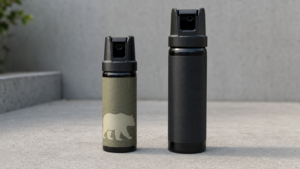
Mace and pepper spray are not the same thing, even though most people use the names interchangeably. Pepper spray contains oleoresin capsicum — a natural oil derived from hot peppers — that causes immediate eye closure, skin burning, and respiratory distress. Mace is a brand name that originally used a chemical irritant unrelated to peppers, though today Mace brand products include OC-based formulas. Knowing which you’re carrying, and what’s actually in it, is not a minor detail.
I’ve been asked this question more times than I can count. And every time, I realize most people have been carrying something for months — sometimes years — without knowing how it actually works. That’s a problem. Not because they made a bad purchase, but because when something happens, you don’t get time to figure it out. You need to already know. Let’s go through this carefully so you walk away with the right information.
What is the original formula of Mace and why does it matter today?
The original Mace — introduced as a personal defense product in the 1960s — used phenacyl chloride, better known as CN tear gas, as its active ingredient. CN gas causes tearing and disorientation, but it has a significant weakness: it works poorly on people who are intoxicated, highly agitated, or simply have high pain tolerance. That’s not a theoretical failure mode. Those are exactly the types of threats most people face when they need a defense spray.
The other problem with CN-based sprays is health risk. Prolonged exposure to CN tear gas has been linked to serious respiratory issues. In the 1980s and 1990s, law enforcement agencies moved away from CN-based products almost entirely, and for good reason. Using a product on a threat that doesn’t work reliably — or that creates a secondary risk to you — defeats the purpose.
Here’s what matters for you right now: the Mace brand still exists and is still sold today, including on this site. But today’s Mace brand products largely use OC pepper spray formulations, not the original CN formula. Some formulas combine OC with additional irritants for enhanced effect. The word “Mace” no longer tells you what’s in the canister — you have to read the label. That distinction is exactly the kind of thing people overlook.
What is pepper spray and how does it actually work on an attacker?
Pepper spray uses oleoresin capsicum — OC — as its active ingredient. OC is derived from capsaicin, the same compound that makes hot peppers hot. When it contacts the eyes, it causes involuntary closure of the eyelids. It inflames mucous membranes in the nose and throat, making breathing difficult. It causes intense burning on exposed skin. These effects are not dependent on pain tolerance. They are physiological responses that happen whether or not the subject wants them to.
That last point is the one people need to understand. A person who is drunk, on drugs, or in a rage-fueled adrenaline state may not feel pain the way a calm person does. OC bypasses that. It doesn’t negotiate with the nervous system — it triggers a physical reaction. That’s why law enforcement transitioned to OC-based products, and why OC is the standard for civilian personal defense sprays today.
What varies between pepper spray products is concentration, measured in Scoville Heat Units (SHU), and the percentage of OC in the formula. A product with 1.33% major capsaicinoids at 2 million SHU behaves very differently from a low-grade 0.5% formula at 500,000 SHU. If you’re carrying pepper spray for personal protection, those numbers matter. A quality 2 oz pepper spray gives you enough volume for multiple deployments without adding significant carry weight — that’s a practical consideration worth thinking through before you buy.
Is the Mace brand the same as generic pepper spray — or is it different?
Mace is a brand. Pepper spray is a product category. This is the most important clarification I can give you, and it’s the one that causes the most confusion.
Today, Mace brand offers several formulas. Some are straight OC pepper spray. Some combine OC with CS tear gas — a different, more modern tear agent than the original CN formula — for what they call a “triple action” effect. CS tear gas adds another layer of irritant response on top of the OC. Whether that combination offers a meaningful tactical advantage for the average civilian is debatable. What matters is that you understand what you’re buying.
Generic pepper spray from other reputable brands — including Wildfire, Pepper Shot, and Streetwise, all of which are carried here — uses OC as the sole active ingredient. Many of these products have very high OC concentrations and SHU ratings. A high-quality single-ingredient OC spray from a reputable brand is a proven, reliable option. Combination formulas are not automatically better — and for some buyers, especially those concerned about legal restrictions on certain chemical agents in their state, simpler may be smarter.
Before you assume the brand name is the deciding factor, read what’s in the canister. Look at the major capsaicinoid percentage and the SHU rating. Those numbers tell you more than any label does.
Are there situations where the difference between Mace and pepper spray changes your outcome?
Yes. And I want to be direct about this without overstating it.
If you’re carrying a product with a CN-based formula — which would be an older product or one you haven’t checked the label on — you may be carrying something that underperforms against an aggressive, intoxicated, or high-pain-tolerance attacker. That is a real risk worth knowing about. CN-based products are not on my recommended list for this reason.
If you’re carrying an OC-based product — whether it’s a modern Mace brand formula, a Wildfire, a Pepper Shot, or a Streetwise — you’re carrying something that has a documented physiological effect across a wide range of subjects. That’s the baseline I’d want anyone to meet.
The delivery format matters too. A belt clip canister with a flip-top safety gives you faster deployment than a canister buried in a bag. Spray pattern — stream, cone, gel, fogger — affects range and exposure risk in different environments. Someone living in an apartment building should think differently about an indoor spray pattern than someone who carries while walking at night. If you’re thinking through living situation and access, pepper spray options designed for apartment use address exactly those indoor-specific considerations.
If you’re a student on a campus, the scenario is different still — crowded areas, close proximity, limited reaction time. Pepper spray for campus safety involves different carry and deployment considerations than home defense. Think through your actual environment before you settle on a canister type and formula.
What should you look at on the label before buying any defense spray?
This is where I see people make the most consistent mistakes. They buy on brand recognition or price without reading anything. Here’s what to check:
- Active ingredient: OC (oleoresin capsicum) should be listed. If you see only CN or CS without OC, that’s a different product class entirely.
- OC percentage: This tells you how much of the formula is the active agent. Higher isn’t always better on its own — this number has to be read alongside SHU.
- Major capsaicinoid percentage: This is the more meaningful number. It tells you the actual concentration of the capsaicinoids responsible for the physiological effect. Look for 1% or above as a reasonable floor.
- SHU (Scoville Heat Units): A measure of heat intensity. Anything below 1 million SHU is lower grade for personal protection purposes. Many quality products run 2 million SHU or higher.
- Spray pattern: Stream is more precise and reduces blowback risk in wind. Cone fog covers a wider area but carries more blowback risk outdoors. Gel sticks on contact and is good indoors. Know what you’re getting.
- Canister size and number of bursts: A small keychain canister may give you 5–6 half-second bursts. A 2 oz canister gives you considerably more. Know your margin.
- Expiration date: Defense sprays lose pressure and potency over time. Check the date. A canister you bought three years ago may not perform the same way.
If a product doesn’t clearly display these details, that itself is information. Quality manufacturers are transparent about what’s in their products because they know the numbers are good. Vague labeling is a warning sign.
If deployment speed is a concern — and it should be — look at the safety mechanism. A flip-top pepper spray allows fast one-handed deployment without fumbling with a twist or slide safety under stress. That’s not a minor feature. Under real stress, fine motor skills degrade. Simpler is faster.
Are there legal restrictions on Mace or pepper spray you need to know about?
Yes, and this is not an area to guess about. I’m not going to give you specific legal advice — that’s not my lane — but I will tell you that laws governing defense sprays vary by state, and sometimes by city or county. Some states restrict canister size. Some restrict the OC percentage. Some require buyers to be a minimum age. A few have specific restrictions on combination formulas — the kind that include both OC and tear gas agents.
Before you buy, spend five minutes looking up the laws in your state. Most state attorney general websites have this information. If you’re buying a combination OC/CS formula — including some Mace brand products — confirm that the CS component is legal in your jurisdiction. This is one of the reasons some buyers prefer a straight OC formula: it’s legal in more places and involves fewer variables to track.
If you work a job that takes you into unfamiliar areas late at night — delivery driving, for instance — this is especially relevant because you may cross county or city lines. Pepper spray for delivery drivers is a practical topic, and the legal dimension of what you’re carrying in a vehicle is part of that conversation.
Frequently Asked Questions About Mace vs. Pepper Spray
Is Mace the same as pepper spray?
Not exactly. Mace is a brand name. The original Mace formula used CN tear gas, not pepper-based OC. Today, Mace brand products use OC formulas, sometimes combined with CS tear gas. Pepper spray as a category always uses oleoresin capsicum as the active ingredient. The terms are often used interchangeably in casual conversation, but they don’t always describe the same product.
Which is stronger — Mace or pepper spray?
Strength depends on the specific formula, not the brand name. What matters is the major capsaicinoid percentage and SHU rating. A high-concentration OC pepper spray from any reputable brand can outperform a lower-grade Mace product, and vice versa. Read the label numbers rather than relying on brand recognition to evaluate strength.
Does pepper spray work on people who are drunk or on drugs?
OC-based pepper spray works better in these situations than CN tear gas does. OC causes involuntary physiological responses — eye closure, respiratory distress — that don’t rely solely on pain perception. This is one of the main reasons law enforcement moved from CN to OC, and it’s a practical reason to verify your spray is OC-based before you need it.
Can Mace or pepper spray permanently injure someone?
OC pepper spray causes temporary effects that typically resolve within 30–45 minutes with fresh air and water. There are no documented cases of permanent injury from properly formulated OC sprays used as directed. CN-based products carry higher risk of respiratory complications, which is another reason OC has replaced CN as the standard. If someone has a pre-existing respiratory condition, the effects may be more severe, but permanent injury from OC is not the norm.
How close do I need to be for pepper spray to be effective?
Effective range depends on spray pattern and canister size. A stream pattern from a 2 oz canister typically reaches 8–12 feet. A cone fogger reaches shorter distances but covers a wider area. Gel patterns are accurate at 10–15 feet in some products. Know your canister’s stated range, and practice reaching for and deploying it before you ever need to use it for real.
How long does pepper spray last before it expires?
Most OC pepper sprays have a shelf life of 2–4 years from the manufacture date, printed on the canister. Over time, the propellant loses pressure and the OC can degrade. A canister past its expiration date may not spray as far or as effectively. Check the date on anything you’ve been carrying for more than a year, and replace it if it’s expired.
Is it legal to carry pepper spray in all 50 states?
OC pepper spray is legal in all 50 states for civilian carry, but restrictions vary on canister size, OC concentration, and buyer age. Some states also restrict combination formulas that include tear gas agents alongside OC. Check the laws in your specific state before purchasing, particularly if you’re buying a combination formula or a larger-volume canister.
What is the difference between OC percentage and SHU in pepper spray?
OC percentage refers to how much of the total formula is oleoresin capsicum. SHU (Scoville Heat Units) measures the heat intensity of that OC. A product could have a high OC percentage but low-quality OC at a low SHU — meaning it’s mostly a weak agent. Look at major capsaicinoid percentage alongside SHU for the most accurate picture of a product’s actual potency.
The distinction between Mace and pepper spray isn’t just trivia. It directly affects what you’re relying on if you ever have to use it. Carry something you’ve read the label on. Know what’s in it, how far it reaches, and how to deploy it without fumbling. If you need help finding the right option for your situation, understanding how to carry pepper spray safely in active situations is a good next step for people who are on the move regularly. And if you’ve had a bad experience and need to know how to treat the burn, how to stop pepper spray burn on skin is worth reading before you need that information under pressure.
I don’t want you to need any of this. But I want you to have the right information — and the right product — if you do.