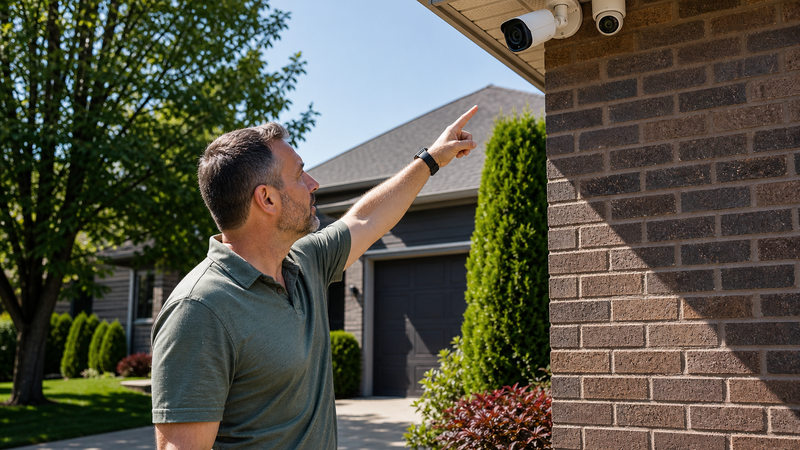
Yes — mixing dummy cameras with real cameras is a legitimate and effective security strategy, and I recommend it. Done correctly, you place real cameras at every critical position where footage actually matters, then use decoys to extend visible deterrence across areas where coverage gaps would otherwise exist. The combination multiplies perceived surveillance without multiplying cost.
That answer has a condition attached to it, though. “Done correctly” is doing a lot of work in that sentence. Too many people flip the formula — they buy mostly dummies, put one real camera somewhere obvious, and call it a system. That is not a security strategy. That is wishful thinking dressed up as preparation. Let me walk you through how to build this the right way, so your setup actually holds up.
Why does mixing real and dummy cameras work as a deterrent?
Deterrence works on perception. A potential intruder casing your property does not know which cameras are real and which are not. What they see is a property that appears to be fully monitored. That uncertainty is the weapon. Most opportunistic criminals are not conducting detailed reconnaissance — they are looking for the easy target on the block. A property covered in cameras, real or otherwise, is not that target.
Studies on residential burglary consistently show that visible security measures redirect criminal behavior rather than eliminate it. The goal is not to make your home impenetrable. The goal is to make it less attractive than the next option. A well-placed mix of real and dummy cameras accomplishes exactly that at a fraction of the cost of full camera coverage.
The power in this approach is that you control the narrative of your property’s security. You are projecting more capability than any single camera budget would allow. That projection is real deterrence, as long as you anchor it with genuine recording where it counts most.
Which positions must have real cameras — no exceptions?
Your front door. Period. This is the most-used entry point for both legitimate visitors and forced entry. It is where package theft happens, where strangers approach, and where law enforcement looks first when something goes wrong. A real camera here does not just deter — it documents. That footage has legal and investigative value. A dummy camera at your front door is a security failure wearing a camera costume.
Your back door or primary rear entry point is the second non-negotiable. Rear entries are statistically more common for forced entry because they offer concealment from the street. If something happens at your back door, you need footage. A dummy there gives you nothing when you need everything.
Your driveway or garage entry — wherever a vehicle or person can approach from a road — earns real camera status as well. This position captures plate numbers, faces, and approach angles. That information matters in a real incident. No dummy camera can give it to you.
If you have a gate, a side yard passage, or a secondary entry used regularly, those positions belong in the real camera column too. The rule is simple: anywhere an incident is likely to occur, or where footage would be used as evidence, gets a real camera. There is no substitute for that footage when you actually need it.
Where do dummy cameras earn their place in a security system?
Dummy cameras earn their place anywhere visible deterrence matters more than documentation. Long fence lines, secondary outbuildings, upper corners of a large parking area, storage sheds, back corners of a yard — these are positions where you want an intruder to see a camera and change their mind, but where the probability of a recorded incident is low.
They also work effectively in interior commercial spaces — retail back rooms, warehouse aisles, break rooms — where full camera coverage would be cost-prohibitive. A realistic-looking decoy at each end of an aisle, backed by real cameras at entry and exit points, creates the impression of total coverage.
For residential use, the dummy cameras for home category covers a wide range of realistic-looking units designed to blend with actual surveillance equipment. If a decoy does not pass a casual visual inspection from ten feet away, it is not doing its job. Realistic housing, a blinking LED, and proper mounting position all contribute to the illusion holding.
Your vehicle is another place where a well-chosen decoy earns its keep. A visible camera mounted inside a car is a known theft deterrent. The dummy cameras for the car options are purpose-built for this — they look convincing from outside the vehicle and require no power source or installation complexity.
What mistakes ruin a mixed camera system?
The most common mistake is clustering real cameras and clustering dummies. When your real cameras all face the driveway and your dummies all face the backyard, a patient observer eventually reads the pattern. Mix them deliberately. Place a real camera between two decoys. Put a decoy in a high-profile position with a real camera slightly less obvious nearby. The arrangement should not telegraph which is which.
Second mistake: buying cheap, obviously fake decoys. If the housing is lightweight plastic that moves in a light breeze, if the mounting bracket looks like it came from a blister pack, or if there is no realistic detail on the lens, it fails at close inspection. Criminals who return to scope a property will notice. Invest in decoys that match the visual profile of real cameras — similar size, similar mounting, similar aesthetic.
Third mistake: no maintenance mindset. Real cameras need functioning power and storage. Dummy cameras with LED blink lights need fresh batteries. A dead blinking light is a signal to anyone paying attention. If your decoy is supposed to simulate an active camera, it needs to behave like one consistently. Build a routine check into your schedule the same way you would test a smoke detector.
Fourth mistake: relying on cameras — real or dummy — as your only layer. Cameras deter and document. They do not physically stop anything. Your security system should include additional layers. Dummy cameras for the front door work best when they are part of a setup that also includes door reinforcement, lighting, and personal protection options for the people inside the home.
How should you position dummy cameras to make them believable?
Mount them at the same height as your real cameras — typically eight to ten feet off the ground. Cameras mounted too high or too low stand out as wrong. Angle them with intention. A camera pointed at a wall or aimed straight up is not credible. It should be angled toward an approach path, an entry point, or an area of open visibility — exactly where a real camera would be aimed.
Weathering and environment matter. A new-looking decoy mounted outdoors for two years should look like it has been there two years. Some units age naturally; others look perpetually out-of-box. In commercial settings, consider a small cable running to or from the unit — even a non-functional cable adds to realism.
Position decoys where lighting supports them. A camera mounted in deep shadow is suspicious. Cameras are typically placed where they can see — which means adequate ambient or artificial light. If a position would not make sense for a real camera, it probably will not hold up as a believable decoy either.
Does a mixed camera system hold up legally?
I am not an attorney and I do not give legal advice. What I will tell you is that the general legal question around dummy cameras comes down to fraud and reasonable expectation of privacy — two areas with real variation by state and jurisdiction. Check your local laws.
What I can say plainly: in most residential and commercial contexts, displaying security cameras — real or simulated — on your own property is not inherently unlawful. Where things get complicated is if someone relies on a claim that cameras were recording when they were not, in a way that causes harm. In a typical home security context, that scenario rarely arises. But know your local rules, and never use a decoy in a position where the legal need for actual documentation is high.
For deeper reading on building complete personal security beyond cameras, the post on self-defense tools every delivery driver should carry covers layered security thinking that applies well beyond that specific audience.
Frequently Asked Questions About Mixing Dummy and Real Security Cameras
How many dummy cameras should I use compared to real cameras?
There is no fixed ratio, but a practical starting point is one real camera for every two to three decoys. The real cameras must cover all high-priority positions — entry points, exits, driveways. Decoys fill in the visual gaps. If your real camera count drops too low, the system loses its documentation value and relies too heavily on deterrence alone, which is a weaker position.
Can a burglar tell the difference between a real camera and a dummy?
An experienced, motivated burglar who takes time to inspect a camera up close may be able to identify a low-quality decoy. Opportunistic criminals — the majority of residential burglars — typically do not get that close before making their decision. A realistic, well-mounted decoy with a functioning blink light will hold up against casual inspection. The goal is deterrence before close examination, not fooling a forensics team.
Do dummy cameras with blinking LED lights look more realistic?
A blinking LED adds to the impression of an active camera, especially at night. It signals power and activity. However, real cameras vary — some have visible LEDs, many do not. If your real cameras do not have a blink light, a decoy that does could actually stand out. Match the visual behavior of your decoys to your real cameras as closely as possible for a consistent, believable system.
Are dummy cameras legal to use on my property?
In most jurisdictions, placing decoy cameras on your own property is legal. The legal complexity increases if you make false representations about the recording to third parties in ways that cause harm. Consult local laws for your specific state. As a general home security measure, decoy cameras are widely used and not typically subject to legal restriction, but that can vary.
Should I put a dummy camera or a real camera at my front door?
Real camera. Always. Your front door is the most critical documentation point on your property. Doorbell incidents, forced entry attempts, package theft, and visitor confrontations all happen there. That footage has real investigative and legal value. A dummy at your front door gives you deterrence but leaves you with nothing if an incident actually occurs. That is not an acceptable trade.
What makes a dummy camera look realistic enough to be effective?
Four things: realistic housing that matches the size and weight of actual surveillance cameras, a properly mounted bracket at standard camera height, a working blink LED if your real cameras have one, and correct aim angle toward an approach path or entry point. Cheap decoys fail on one or more of these points. If it does not pass a ten-foot visual inspection in daylight, it will not hold up in use.
Can I use dummy cameras indoors as well as outdoors?
Yes. Indoor decoys work well in retail environments, offices, and commercial spaces where full camera coverage is cost-prohibitive. In residential use, they are less common indoors but not unheard of — some homeowners place them in garages or storage areas. Weather-rated housings are designed for exterior use; interior-only decoys typically have less weatherproofing but are otherwise comparable in function.
What else should I combine with a mixed camera system for real home security?
Cameras deter and document — they do not stop entry or protect you once someone is inside. Layer your security. Strong door hardware, motion-activated lighting, a quality alarm system, and personal protection tools for the people in the home all matter. A camera system, real or mixed, is one component of a complete approach, not a standalone solution.
A mixed camera system, built with real cameras at every critical position and quality decoys filling the visual gaps, gives you a serious security presence at a reasonable cost. That is a defensible position. It projects capability, it documents what matters, and it makes your property look like exactly the kind of place a criminal should skip over.
Start with your entry points. Lock in real cameras there without compromise. Then build outward with decoys that match the profile and placement of your real units. If you want to add personal protection for the people inside the home alongside your camera strategy, browse the full range at stun-guns.com — because a camera system protects your property, and you still need something that protects you.