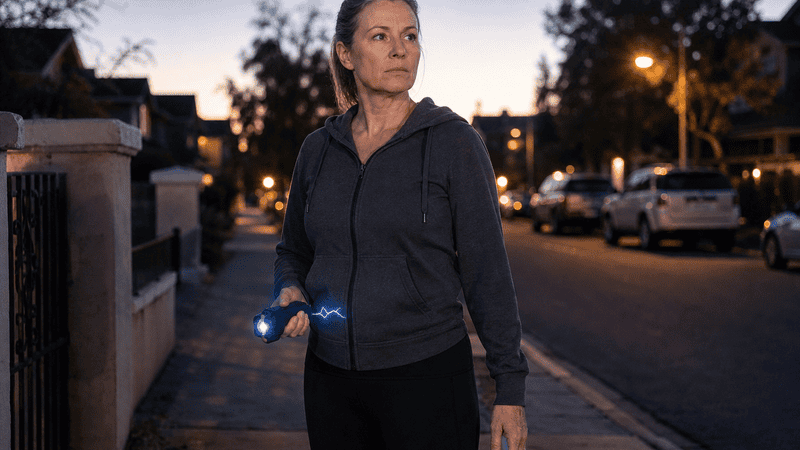
Yes, a stun gun can work as a deterrent without ever making contact. The electric arc — that loud, crackling discharge between the prongs — is visible, audible, and immediately understood as a threat by almost anyone nearby. Most people with bad intentions will reconsider the moment they see and hear it. Contact is the last resort, not the first step.
What actually happens when you fire a stun gun in the air?
When you press the trigger on a stun gun without pressing it against a target, the electricity jumps between the two contact points and produces a bright, jagged arc. That arc is accompanied by a sharp, cracking sound — something between a spark and a small crack of thunder. In a quiet parking lot at night, it carries.
That combination — light, sound, and the unmistakable smell of ozone — sends a clear signal. Anyone within 20 to 30 feet knows exactly what they’re looking at. It doesn’t take training to recognize the threat. It’s visceral. The sound alone triggers a fear response in most people.
This is the deterrent effect. And it works precisely because a stun gun is not subtle. You don’t have to explain it. You don’t have to warn someone twice. A single trigger press in their direction makes the situation clear.
Understanding what’s behind that arc can also help you make a smarter product choice. If you want to know more about how stun gun voltage actually factors into stopping power, I’ve covered that in detail in this post on stun gun voltage and what actually stops a threat.
How far away does the deterrent effect actually work?
The deterrent effect of a stun gun is real, but it has limits you need to understand. The arc itself is only visible at close range — roughly 20 to 30 feet under low light conditions, less in full daylight. The sound carries farther, but it’s the visual that does the heavy lifting on deterrence.
If someone is 50 feet away and it’s a bright afternoon, they may not register the arc at all. Distance reduces the effect significantly. This is why your positioning matters as much as the device itself.
In a confined space — a stairwell, a parking garage, a hallway — the deterrent effect is amplified. The sound bounces. The light reflects. Someone thinking about doing something stupid has a harder time talking himself into it when a stun gun arc is cracking six feet away.
In open outdoor spaces at a distance, the visual deterrent weakens. That’s when additional tools — a loud personal alarm, a stun gun with a built-in LED light that can be aimed at someone’s eyes, or a combination device — become part of the equation. One tool is a good start. A layered approach is better.
What makes a stun gun more effective as a deterrent before contact?
Not all stun guns produce the same deterrent effect. A few specific features matter more than others when your goal is to stop a situation before it escalates to contact.
Loud arc. The sound of the discharge is part of the deterrent. Some units produce a sharper, louder crack than others. A quiet stun gun wastes half its deterrent value. Listen for descriptions of arc intensity when choosing a unit.
Visible arc. A bright, high-contrast arc between clearly visible electrodes reads faster in a threat scenario. Some designs produce a more visible arc than others. A device that looks capable gets taken more seriously.
Built-in alarm. A stun gun with an alarm feature adds a second layer. A 120dB siren draws attention from bystanders, which is often exactly what an aggressor wants to avoid. The combination of an electric arc and a screaming alarm sends a very direct message: this situation is about to become very public and very painful.
Integrated flashlight. A high-lumen beam aimed directly at someone’s face temporarily degrades their vision. That’s a deterrent in itself, before the arc ever fires. It also lets you identify whether a threat is real before committing to action.
These features aren’t luxury upgrades. In a deterrence context, they’re the whole point. A basic stun gun with a weak arc and no secondary features does the job at contact range. A well-built unit with visible arc, loud discharge, alarm, and light gives you options before that moment arrives.
Is using a stun gun as a deterrent legal if you don’t make contact?
This is where I have to be direct with you: I’m not an attorney, and self-defense law varies significantly from state to state and even city to city. I can’t give you legal advice, and I won’t pretend to.
What I can tell you is this: in most U.S. jurisdictions, the lawful use of a stun gun — including displaying it as a deterrent — is tied to the concept of reasonable threat. If a reasonable person in your position would feel threatened, the display of a defensive tool is generally considered a proportionate response. Discharging it into the air as a warning shot follows a similar standard in most places.
That said, some jurisdictions treat the visible display of a stun gun the same as brandishing a weapon. Others have specific restrictions on where stun guns can be carried or how they can be used. Before you carry, know your local laws. That’s not a suggestion. That’s a requirement.
The non-lethal nature of stun guns does not exempt them from regulation. Non-lethal is not the same as unregulated. Know the difference.
Who relies on deterrence most — and why they should plan accordingly?
The deterrence strategy isn’t unique to any one type of person. But certain situations call for it more than others.
Maintenance workers, delivery drivers, and anyone who enters unfamiliar properties alone — often after dark — face elevated exposure to unpredictable encounters. A stun gun on a belt clip that’s visible and accessible is both a practical tool and a passive signal. Most people with hostile intentions are looking for easy targets. Someone visibly prepared is not an easy target. If your work puts you in those situations regularly, there are units specifically suited to your needs — take a look at options built for maintenance and field workers.
College students walking back to housing at night. Seniors living alone. Parents in high-traffic urban areas. Each of these groups benefits from understanding that a stun gun’s deterrent value is available before the worst happens — not just during it.
The key word is preparation. You don’t get to choose when a threat appears. You do get to choose how ready you are when it does.
What should you do if deterrence doesn’t work?
Deterrence fails. Not often — but it does. Someone who is chemically impaired, mentally unstable, or simply committed to causing harm may not respond to a visual or auditory warning the way a rational person would. You need to be ready for that.
If deterrence fails and someone continues to close distance on you, the calculus changes. At that point, a stun gun functions as a contact weapon. Direct application to exposed skin — neck, arms, torso — delivers a powerful electric shock that disrupts muscle control temporarily.
That’s the backup plan. And having it requires that your stun gun is charged, accessible, and that you’ve practiced deploying it before an emergency. A stun gun you’ve never taken out of the box is not a safety plan. It’s a purchase you made once and forgot about.
Practice the draw. Know where the trigger is without looking. Make sure it’s charged. Those three things take 10 minutes a month. They matter more than the brand name on the unit.
Frequently Asked Questions About Using a Stun Gun as a Deterrent
Can you fire a stun gun in the air as a warning?
Yes, you can discharge a stun gun without a target — the arc fires between the contact prongs and produces a visible flash and loud crackling sound. This is a common deterrent tactic. Whether doing so is legally appropriate in your jurisdiction depends on local law, so check your state and local regulations before relying on this as part of your plan.
How loud is a stun gun arc?
The arc discharge on most stun guns produces a sharp cracking sound roughly comparable to a cap gun or a small electrical snap. In a quiet environment — a parking garage, a residential street at night — it carries well and is immediately recognizable. Units vary in arc intensity, so louder, more aggressive arcs provide stronger deterrent effect than quieter models.
Does a stun gun work as a deterrent in daylight?
It works, but less effectively than in low-light conditions. The arc is harder to see in full daylight, which reduces the visual impact. The sound still carries and still signals danger. For daytime use, a stun gun with a high-lumen flashlight or a built-in personal alarm adds deterrent value that doesn’t depend on arc visibility.
Will a stun gun arc scare off an animal as well as a person?
The sound and light of a stun gun arc can startle animals and cause them to retreat. Many people use this tactic against aggressive dogs. It’s not a guaranteed outcome — especially with a charging or highly agitated animal — but the sudden loud crack and flash has interrupted many animal encounters before contact became necessary. It’s a reasonable first response.
Do I need to make contact for a stun gun to be effective?
No. The deterrent effect — arc, sound, light — is real and often effective without contact. However, the electrical shock that disrupts muscle function only occurs with direct skin contact. If deterrence doesn’t stop a threat, you’ll need to make contact to neutralize it. Know both capabilities so you’re not caught expecting one when you need the other.
Can someone just ignore the arc and keep approaching?
Yes. Deterrence is not guaranteed. A person who is severely impaired, emotionally disturbed, or highly committed may not respond to a visible arc and sound warning. This is why you should always treat deterrence as a first line of response, not a complete strategy. Physical contact capability, distance management, and awareness of exits remain important even when you’re carrying.
Does the stun gun need to be fully charged to produce an arc?
A low battery can weaken the arc significantly. A weak arc produces less light and less sound — both of which reduce the deterrent effect. It also reduces contact-level performance. Treat your stun gun like your phone: charge it on a regular schedule, not just when it dies. Monthly charging is the minimum standard for a device you’re counting on.
What’s the difference between a stun gun arc and a TASER?
A stun gun requires direct contact to deliver a shock. The arc you see is internal — between its own prongs. A TASER fires two probes on wires up to 15 feet and delivers a shock at that distance. Both are non-lethal tools, but TASERs offer standoff capability that stun guns do not. For deterrence, a stun gun arc is visible and effective. For range-based deployment, a TASER is a different category of tool.
The Bottom Line
A stun gun’s job doesn’t start when it makes contact. It starts the moment someone sees and hears that arc. That’s the window where most situations resolve — before anyone gets hurt. Use that window. Give yourself the best chance of never needing the contact phase at all.
I don’t want you to need any of this. But I want you to have it if you do — and I want you to have thought through how it works before the moment arrives. Browse our full selection of non-lethal self-defense stun guns and find the one that fits how you actually live and move through the world.