For elder care monitoring in low light, the best hidden cameras combine infrared night vision, a minimum 1080p HD sensor, and a discreet form factor that fits naturally into a living space. A power outlet camera or a clock-style unit with always-on power eliminates battery gaps. Prioritize devices with motion-triggered recording and local SD card storage so footage is never dependent on a stable internet connection.
I spent a long time working in environments where surveillance wasn’t optional — it was the difference between an incident getting documented and one disappearing without accountability. Elder care is different from base security, but the standard of what’s acceptable doesn’t drop. It rises. When the person you’re protecting can’t always speak for themselves, the equipment you choose carries weight. You don’t want something that almost works. You want something that delivers every time the room goes dark.
What makes a hidden camera perform well in low light conditions?
Low light performance comes down to two things: the sensor and the infrared system. A camera can advertise 4K resolution and still produce useless footage at night if the lens aperture is too narrow or the IR LEDs are underpowered. The sensor size matters more than the resolution number on the box. A larger sensor gathers more light per pixel. That’s physics, not marketing.
Look for cameras rated to perform at or below 0.1 lux — that’s the low light threshold that separates capable equipment from equipment that looks capable on paper. Infrared illumination range is equally important. A camera with a five-foot IR range will not give you usable footage across a bedroom. Fifteen to thirty feet of infrared range is the standard you should be working toward for most indoor elder care settings.
Auto IR switching — the ability for the camera to seamlessly shift from color daytime recording to black-and-white infrared recording at dusk — is a feature worth paying for. Cameras that require manual adjustment, or that produce blurry, grain-heavy transitions, introduce gaps. Gaps are the problem you’re trying to eliminate.
Why does form factor matter as much as image quality for elder care cameras?
A camera that makes an elderly person feel watched in their own home has already failed its purpose. The goal of hidden camera monitoring in elder care is not surveillance in the punitive sense. It’s documentation. It’s peace of mind. It’s having footage to review if a caregiver reports a fall and something about the timeline doesn’t add up.
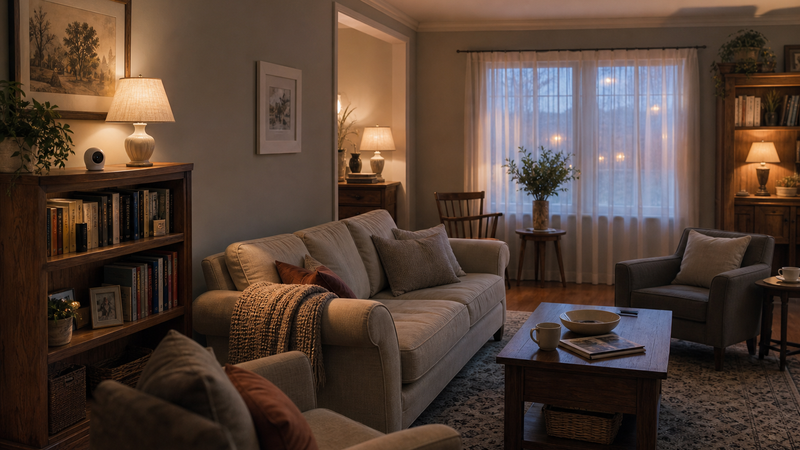
Form factor is the difference between a tool that works quietly in the background and a device that introduces tension into a space where your loved one needs to feel safe and dignified. A hidden camera power outlet integrates seamlessly into any room without drawing attention. It looks exactly like every other outlet on the wall. That’s not deception — that’s discretion. There’s a meaningful difference.
Clock cameras, smoke detector cameras, and picture frame cameras all serve this same principle. They occupy the space naturally. They don’t signal surveillance. For elder care specifically, the less the camera announces itself, the more humane the setup. Your parent or grandparent shouldn’t feel monitored. They should simply be protected.
What resolution do you actually need for elder care monitoring footage to be useful?
1080p is the practical floor. Anything below that — 720p or older SD resolutions — will not give you the detail you need if footage ever needs to be reviewed for something serious. You need to be able to identify faces, read body language, and see the specifics of an interaction. That requires resolution with actual density behind it.
A quality HD hidden camera built for indoor use will give you that 1080p baseline while keeping the form factor appropriate for a living room or bedroom. Some devices step up to 2K or 4K. For elder care monitoring — as opposed to retail loss prevention or commercial security — 1080p at a high bit rate consistently outperforms 4K at a low bit rate. The bit rate determines how much detail is preserved in motion, particularly in low light. A high-resolution file that compresses heavily in the dark is not a premium product. It’s a number on a spec sheet.
Sharpness at the edges of the frame matters too. Wide-angle lenses can cover a full room, but cheaper lenses produce barrel distortion and blurring toward the corners. If a caregiving interaction happens near the edge of the frame — which it often does — you want that footage to be as clear as the center.
How long should a hidden camera be able to record without intervention?
For elder care, continuous recording capability is not a luxury — it’s a requirement. Battery-powered cameras have a role in some applications, but if you’re monitoring a space where a caregiver is present for eight to twelve hours at a stretch, you need power. A hardwired or continuously powered device doesn’t leave gaps.
If you are using a long battery hidden camera for supplemental coverage — a second angle, a hallway, a location where running a cord isn’t possible — look for units rated at eight hours minimum on a full charge, with motion-activation to extend that runtime. Motion-triggered recording is smarter than continuous recording in many elder care environments because it preserves storage space for the moments that actually matter.
Local SD card storage is worth emphasizing here. Cloud-dependent cameras stop working the moment the Wi-Fi goes down or the subscription lapses. A camera writing to a 128GB SD card on-device keeps recording regardless of network conditions. For a senior living alone or in a home care arrangement, that reliability is non-negotiable.
What placement strategies give you the best coverage in a typical elder care room?
Placement is a skill. The best camera in the wrong position gives you footage of a ceiling fan. Think about where caregiving interactions actually happen: the bedside, the medication area, the chair or couch where your loved one spends the most time. Those are your priority zones.
A camera positioned at eye level — or slightly above — gives you the most interpretable footage. Overhead angles are dramatic in film. In real-world monitoring, they flatten faces and make it harder to read what’s happening. A power outlet camera at standard outlet height gives you exactly the angle you need: straight-on, at the level of human activity.
For rooms with a single primary caregiving area, one well-placed camera with a wide-angle lens — 90 to 120 degrees — is often sufficient. For larger spaces or rooms with multiple activity zones, consider two cameras with overlapping fields of view. Redundancy in coverage is the mark of a thoughtfully designed setup. It’s also protection against a single camera being accidentally blocked by furniture or a caregiver’s body.
If you’re ever staying somewhere unfamiliar and want to check for cameras someone else may have placed — a concern that comes up for families using respite care or temporary facilities — the principles in this guide to checking a hotel room for hidden cameras apply directly to that situation as well.
Is it legal to use hidden cameras for elder care monitoring in your home?
Generally speaking, recording in your own home for the purpose of monitoring care is legal in most U.S. states. Many states have passed specific “granny cam” legislation that explicitly protects a family’s right to monitor care in private residences and, in some cases, licensed facilities. The specifics vary by state, and audio recording carries stricter regulations than video in many jurisdictions.
I’m not going to tell you what the law is in your specific state — that’s a conversation for an attorney. What I will tell you is that knowing the rules before you install is the right order of operations. Most families who use elder care cameras do so openly, informing professional caregivers that monitoring is in place. That transparency often improves care quality on its own. The camera doesn’t have to be a secret to be effective.
Frequently Asked Questions About Hidden Cameras for Elder Care Monitoring
What is the best type of hidden camera for monitoring an elderly parent at home?
A power outlet camera or clock camera provides the best combination of continuous power, discreet placement, and reliable low light performance for elder care. These units integrate naturally into a home environment, record without gaps, and typically include infrared night vision and motion detection. For most living rooms and bedrooms, a single wide-angle 1080p device positioned at outlet height covers the primary caregiving area effectively.
Do hidden cameras for elder care need Wi-Fi to work?
No. Many quality hidden cameras support local SD card recording without any Wi-Fi connection. Wi-Fi connectivity is useful for remote viewing on your phone, but it should not be a dependency for recording. A camera that only records to the cloud will stop capturing footage if the network drops. For elder care, choose a device with onboard storage as the primary recording method and Wi-Fi as an optional feature.
How far can hidden cameras see in complete darkness?
Most quality indoor hidden cameras with infrared night vision have an effective range of 10 to 30 feet in complete darkness. The specific range depends on the number and power of the IR LEDs built into the unit. For a standard bedroom or living room, 15 feet of infrared range is typically sufficient. Verify the manufacturer’s stated IR range before purchasing — it is one of the most important performance specs for low light use.
Should I tell a hired caregiver that I have a hidden camera?
In most cases, yes — and in some states, disclosure to professional caregivers is legally required. Beyond the legal question, transparency often improves care outcomes. Caregivers who know they are being monitored tend to be more consistent in their routines and documentation. The camera’s value is not diminished by disclosure. Its purpose is documentation and accountability, not gotcha surveillance. Consult an attorney about the disclosure requirements in your state.
Can I use a hidden camera in an assisted living facility?
Laws vary significantly by state. Many states have passed legislation allowing families to place cameras in a resident’s private room in a licensed facility, provided the resident consents and the facility is notified. Some states require the camera to be visible. Others permit discreet placement. Check your state’s specific statutes before installing any monitoring device in a facility setting. Your elder care attorney or state ombudsman office is the right resource here.
What is the difference between motion detection and continuous recording for elder care?
Continuous recording captures everything but fills storage quickly and creates hours of footage to review. Motion-triggered recording activates only when movement is detected, which preserves storage and makes review more practical — the camera logs events, not empty rooms. For elder care, motion detection with a pre-event buffer (which captures a few seconds before the trigger) is usually the more intelligent choice. It keeps the footage manageable without sacrificing coverage of meaningful moments.
How much storage do I need for elder care camera footage?
A 64GB SD card holds approximately 8 to 12 hours of 1080p continuous footage, depending on compression. A 128GB card is a more practical choice for elder care, providing 16 to 24 hours of buffer before the oldest footage is overwritten. Most hidden cameras use loop recording, which automatically overwrites the oldest files when the card is full. If you need to preserve specific footage, copy it to another device before it cycles out.
Are hidden cameras only useful if something goes wrong?
No. Most families who install elder care cameras report that the footage is never needed for anything serious — and that’s the goal. The value is in the deterrence, the peace of mind, and the ability to verify that routines are being followed consistently. Knowing a camera is present often improves a caregiver’s attentiveness. The camera is there for the exception. Its real value is in making the exception less likely to occur.
The right hidden camera for elder care isn’t the one with the most features listed on the packaging. It’s the one that performs reliably in the specific conditions of your loved one’s space — low light, long hours, and a setting that deserves to stay comfortable and dignified. That standard is worth holding firm on. Capable equipment exists at every price point, but you should know what you’re actually evaluating before you buy.
If you want to explore your options, the HD hidden camera category at stun-guns.com is a practical starting point. And if elder care monitoring is part of a broader conversation about safety for the people in your life, you might also find value in the practical guidance on personal safety tools for women — because protection doesn’t stop at the front door.