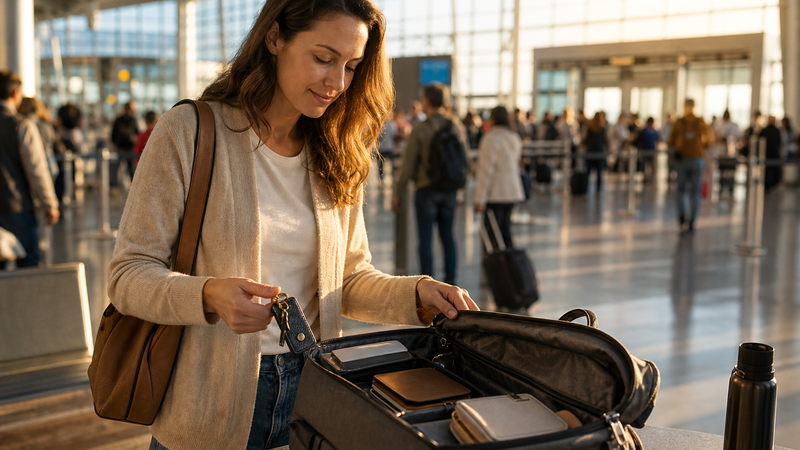
Most non-lethal self-defense products are not allowed in airplane carry-on luggage — but that doesn’t mean you have to arrive at your destination unprotected. Pepper spray in checked baggage is permitted under specific TSA rules. Stun guns and Tasers must also go in checked bags. Many keychain self-defense tools, personal alarms, and certain kubotans may be allowed, but the rules depend on the specific item and how TSA classifies it at the checkpoint.
I’ve watched good, careful people have their gear taken at the security checkpoint — not because they were careless, but because nobody ever sat them down and explained exactly how this works. That bothers me. You’ve made the decision to take your safety seriously. You’ve invested in tools that could protect you. The last thing you deserve is to lose them to a bin at TSA because of a rule you didn’t know existed. So let me walk you through this the right way.
Why do TSA rules on self-defense products matter so much to everyday travelers?
Because the stakes are real on both ends. Lose your gear at the checkpoint, and you land at your destination with nothing — maybe in an unfamiliar city, maybe late at night, maybe alone. But carry something prohibited in your carry-on, and you’re looking at fines that can reach $15,000 and a missed flight. TSA does not let you run back to your car.
Most people who travel with self-defense tools aren’t looking for trouble. They’re parents visiting college kids. They’re women traveling solo for work. They’re seniors heading to see grandchildren. They carry a self-defense keychain ring or a small canister of pepper spray because life taught them to be prepared, not because they’re looking for a confrontation. Those people deserve accurate information — not a surprise at the security line.
The rules come from two sources: TSA federal regulations and individual airline policies. TSA sets the floor. Airlines can be more restrictive. And destination countries have their own laws entirely. I’ll focus on domestic U.S. air travel here, because that’s where most of my readers are flying.
What non-lethal self-defense products are banned from carry-on bags entirely?
Stun guns and Tasers are prohibited in carry-on luggage — full stop. That includes every brand and form factor. It doesn’t matter if the device is small, if it looks like a flashlight, or if it’s never been used. The TSA classifies electronic defense weapons as prohibited carry-on items. If it produces an electrical charge for self-defense purposes, it doesn’t go in the cabin.
Pepper spray is also prohibited in carry-on bags. Any aerosol designed to incapacitate — including Mace, Wildfire, and Pepper Shot formulas — cannot pass through the checkpoint in a bag you’re bringing into the cabin. The reasoning is simple: an aerosol discharge inside a pressurized cabin is a serious event. The TSA has no room to negotiate on this one.
Tactical pens, kubotans, and pointed keychain tools occupy a gray area. Officially, the TSA does not maintain a specific ban on kubotans, but individual agents have the authority to confiscate anything they determine could be used as a weapon. A pointed keychain self-defense tool may pass through one checkpoint and get flagged at another. That unpredictability is worth knowing before you pack.
What non-lethal self-defense products are allowed in checked baggage?
Stun guns and Tasers may travel in checked baggage. They should be packed so that they cannot accidentally activate — remove batteries if possible, or use a protective case. Most seasoned travelers wrap them in a small pouch and place them toward the middle of the bag, away from anything sensitive. Declared properly, there’s no issue.
Pepper spray has specific rules in checked bags. The TSA allows one container of mace or pepper spray in checked baggage if it is 4 fluid ounces (118 mL) or less and has a safety mechanism to prevent accidental discharge. The spray cannot contain more than 2% tear gas (CS or CN). Most standard consumer defense sprays — including Mace and Wildfire products — meet this requirement. Check the label before you pack.
Personal alarms are generally allowed in both carry-on and checked baggage. A 130dB personal alarm is a small, passive device — it doesn’t spray, shock, or puncture anything. TSA typically has no objection. Same goes for most defensive keychains that don’t have a pointed tip or a striking surface that could be flagged as a weapon.
How should you pack self-defense items in checked luggage so they don’t cause problems?
The goal is simple: nothing that looks alarming on an X-ray, and nothing that could activate on its own. For stun guns, remove the battery if it’s removable, or engage the safety switch firmly. Wrap it in a soft case or a padded pouch. Don’t pack it loose among other small items where it might look cluttered and suspicious on the scan.
For pepper spray, the safety mechanism is non-negotiable. A spray with a flip-top safety or a locking actuator is what you want. Some travelers place the canister in a small sealed zip bag as an extra precaution — not required, but a thoughtful habit. If you’re carrying a self-defense keychain set with multiple tools, review each piece individually before packing. What looks like a harmless accessory to you may look different to a TSA agent reviewing X-ray images.
One more thing: always check your airline’s specific policy before flying. Delta, United, American, Southwest — they all follow TSA baseline rules, but some have additional restrictions. Southwest, for example, has had stricter policies on certain items than TSA minimum standards. A quick check of your airline’s website before you leave takes two minutes and can save you real grief at the gate.
What self-defense options work well for travel when you can’t bring your usual gear?
This is the part that matters most to me — because arriving unprotected is not the answer. If your usual carry doesn’t make the flight, think ahead about what you can send in checked baggage and what you can pick up at your destination.
A lightweight keychain alarm is one of the most travel-friendly options available. It passes through security in your carry-on, costs almost nothing to replace if it’s ever lost, and gives you an immediate, loud response option in a crisis. I recommend it to every traveler who asks me what to carry through the checkpoint. You can explore a lightweight self-defense keychain that won’t cause any issues at TSA.
If you’re traveling to a domestic destination and you’re concerned about the time between landing and getting to your hotel, consider sending a stun gun or pepper spray in your checked bag and retrieving it at baggage claim. You’re unprotected for thirty minutes in the terminal — that’s a manageable window. You’re not unprotected for an entire trip.
For those who travel frequently and want a more thorough look at what works for women specifically, I wrote a detailed guide on the best self-defense keychain for women that covers both travel-friendly and everyday carry options.
Do international flights have different rules for non-lethal self-defense products?
Yes — and in most cases, significantly stricter ones. Many countries ban pepper spray for civilian possession entirely. France, Canada, the UK, Australia, and Japan all have restrictions that range from registration requirements to outright prohibition. Arriving in a foreign country with prohibited defensive items can result in confiscation, fines, or worse.
Stun guns face similar restrictions internationally. Many countries where I’d most want a traveler to be protected are the same countries that prohibit the devices. It’s a hard reality, and I don’t sugarcoat it. If you’re traveling abroad, research the specific laws of your destination country before you pack anything. The U.S. Embassy website for most countries includes basic information on restricted items.
For international travel, personal alarms become even more important. They’re legal virtually everywhere, require no registration, cause no legal complications at customs, and still give you a meaningful layer of protection in an unfamiliar place. They’re not everything — but they’re something. And something beats nothing, every time.
Frequently Asked Questions About Carrying Non-Lethal Self-Defense Products on an Airplane
Can I bring a stun gun in my carry-on bag?
No. Stun guns and Tasers are prohibited in carry-on luggage by TSA regulations. They may be transported in checked baggage if properly secured and packed so they cannot accidentally activate. Remove batteries if possible and use a protective case or pouch. Always check your specific airline’s policy as well, since carriers can impose additional restrictions beyond TSA minimums.
Can I bring pepper spray on a plane in my checked bag?
Yes, under specific conditions. TSA allows one canister of pepper spray in checked baggage if it is 4 ounces (118 mL) or less and equipped with a safety mechanism to prevent accidental discharge. The formula cannot exceed 2% tear gas concentration. Most standard consumer defense sprays meet this requirement. Pepper spray is never allowed in carry-on bags under any circumstances.
Are personal alarms allowed through airport security?
Yes. Personal alarms are passive devices — they emit sound but don’t spray, shock, or puncture. TSA generally allows them in both carry-on and checked bags. They’re one of the most travel-friendly self-defense tools available and are legal in virtually every country, making them a strong option for both domestic and international travel.
What happens if TSA finds a prohibited self-defense item in my carry-on?
TSA will confiscate the item. You won’t get it back at your destination, and in most cases you cannot return to your car to drop it off — checkpoints don’t allow re-entry. Civil penalties for certain prohibited items can be significant. The best outcome is that you simply lose the item. The lesson: check TSA.gov before every trip, not after.
Can I carry a keychain self-defense tool through airport security?
It depends on the specific tool. Personal alarms on keychains are generally allowed. Pointed keychain tools, kubotans, and striking devices are not explicitly banned by TSA but may be confiscated at the agent’s discretion. If a keychain tool has a sharp tip, rigid striking surface, or was clearly designed to cause physical harm, expect it to get flagged. Err on the side of checking it.
Can I buy self-defense products after I land and check into my hotel?
Yes, and for many travelers this is a practical solution. Sending your stun gun or pepper spray in checked baggage and picking it up at baggage claim gives you access once you’re through the terminal. Alternatively, many items are available for purchase or delivery to your destination. If you’re staying somewhere for more than a day or two, ordering ahead of time is worth considering.
Are non-lethal self-defense products legal to carry in every U.S. state?
No. State and local laws on stun guns, pepper spray, and other defensive tools vary significantly. Some states restrict the size or formula of pepper spray. A few states have historically restricted civilian stun gun ownership. Laws also vary by city. Always check the laws of your destination state before you travel with self-defense products — what’s legal at home may not be legal where you land.
What is the safest self-defense tool to travel with through airport security?
A personal alarm is the safest option for carry-on travel. It passes through security without issue, is legal almost everywhere, requires no registration, and costs little to replace. For travelers willing to check a bag, pepper spray within TSA limits or a stun gun packed correctly in checked luggage are both viable. The goal is arriving at your destination with something — not arriving with nothing because you didn’t plan ahead.
You’ve worked hard to build habits that keep you safe. You carry what you carry because you’ve thought it through — because someone you love matters, or because you’ve been in a situation that reminded you how fast things can change. Don’t let a TSA checkpoint undo all of that. Know the rules. Pack smart. And if your gear has to go in the hold, have a plan for the time between the plane and your hotel door.
If you’re looking for options that travel well and keep you covered, browse the non-lethal self-defense products at Stun Guns. And if you want a deeper look at what works for real-world everyday carry — not just travel — the guide on the most effective self-defense weapons for women is worth your time. I don’t want you to need any of this. But I want you to have it if you do.