Content Quality Gate passed — all five checks verified.
A self-defense knife should have a blade between 3 and 4 inches, a reliable locking mechanism, a handle that stays secure in your grip under stress, and a carry system that lets you access it quickly with one hand. Beyond those core features, the right knife is the one you can carry legally in your area, deploy without fumbling, and maintain without special tools.
I want to be straight with you about something before we go further. A knife is a lethal weapon. That distinction matters — legally, ethically, and practically. I carry one. A lot of people do. But choosing one for self-defense is a different decision than choosing one for camping or utility work. This post is about helping you make that decision clearly, without overselling you on gear you don’t need or underselling you on features that actually matter when it counts.
Let’s go through it methodically.
What blade length is best for a self-defense knife?
For most people carrying a knife primarily for personal protection, a blade between 3 and 4 inches is the practical range. It’s long enough to be effective as a defensive tool, short enough to be legal in most U.S. jurisdictions, and compact enough to carry without it becoming a burden.
Blades shorter than 3 inches exist and are legal almost everywhere, but they significantly reduce your options if you ever need to use the knife defensively. Blades longer than 4 inches start running into legal restrictions in many cities and states, and they’re harder to carry concealed and deploy quickly. The 3-to-4-inch range is where most serious everyday carry knives land for a reason.
Don’t let blade length be the first thing that draws your eye in a product listing. A 2.8-inch blade on a knife you can actually carry every day beats a 4.5-inch blade sitting in your glove box because it was too bulky to wear.
What type of locking mechanism should a self-defense knife have?
A folding knife without a solid lock is a liability. In a defensive situation, your grip tightens, your hands may be sweating, and the last thing you can afford is a blade that folds back onto your fingers. This is not a hypothetical risk — it happens, and it’s serious.
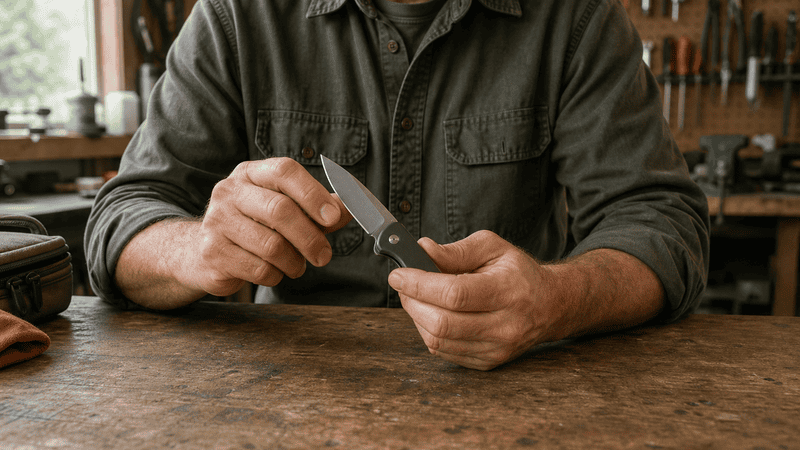
The most reliable locking mechanisms for everyday carry self-defense knives are the liner lock, frame lock, and lockback. Each works differently, but all three hold the blade open under hard use when properly made. The frame lock and liner lock are the most common in modern folding knives and allow for smooth one-handed operation, which matters when your other hand may be occupied.
Avoid cheap knives with assisted-open mechanisms that feel loose or wobbly when the blade is deployed. Test the lock yourself before you rely on it. Open the blade, grip the spine firmly, and try to fold it back with your thumb without touching the release. A good lock doesn’t move. If it wiggles, find another knife.
What handle features matter most for self-defense use?
Handle design is where a lot of buyers make compromises they later regret. A good self-defense knife handle does three things: it stays in your hand under a hard grip, it keeps your hand in the right position so you don’t slide onto the blade, and it’s comfortable enough that you’ll actually carry the knife daily.
Look for a handle with some form of texture — G10, rough-finished aluminum, or textured polymer all work. Smooth metal handles look clean but become slippery under stress or in wet conditions. A finger groove or guard at the front of the handle is a practical safety feature, not just an aesthetic choice. It keeps your grip indexed and your fingers forward of the blade.
Handle thickness matters too. If the knife is uncomfortable to hold for more than a few seconds, you won’t practice with it, and if you don’t practice drawing and deploying it, it won’t help you when you need it most. Ergonomics isn’t vanity — it’s function.
How should a self-defense knife open, and why does it matter?
One-handed deployment is not optional for a self-defense knife. If opening the blade requires two hands, a flat surface, or a deliberate sequence of steps, it’s a work knife — not a defensive one. In a defensive situation, your other hand may be pushing someone away, holding a bag, or bracing against a wall. You need to open the blade with the same hand holding the knife.
Thumb studs, flipper tabs, and wave features all allow reliable one-handed opening. Assisted-opening mechanisms add speed, but they vary in quality. A well-made assisted opener from a reputable manufacturer deploys crisply and locks with authority. A cheap one jams, fires unexpectedly, or fails to lock fully.
Automatic knives — often called switchblades — are heavily regulated and illegal to carry in many states. Know your local laws before you consider one. For most people, a well-made manual or assisted folder is the better choice anyway: simpler mechanism, fewer points of failure, and legal nearly everywhere.
What carry options should I consider for a self-defense knife?
A knife you can’t access quickly isn’t a self-defense tool — it’s just extra weight. The clip position and carry depth determine how fast you can draw the knife when you need it.
Most modern folding knives come with a pocket clip. Look for one that allows tip-up carry, meaning the tip of the blade faces upward in your pocket. From this position, you can draw the knife, rotate it into your palm, and open the blade in one continuous motion. Tip-down carry reverses that sequence and adds an awkward step.
Deep-carry clips position the knife low in the pocket so only the clip shows. These are good for concealment and discretion. Standard clips leave the handle more accessible but more visible. Both are legitimate choices depending on your environment and priorities.
If you’re also building out a broader personal safety kit, it’s worth knowing that a knife isn’t always the right first tool. For delivery drivers, runners, or anyone who spends time alone in unfamiliar areas, a layered approach to self-defense tools often makes more sense than relying on any single item.
What steel and blade grind should I look for in a self-defense knife?
You don’t need a metallurgy degree to make a good decision here, but a few basics help. Steel quality determines how long the blade holds an edge and how resistant it is to corrosion. For a self-defense knife that may also see daily utility use, you want steel that’s tough, holds a working edge with reasonable maintenance, and doesn’t rust if it gets wet.
Common reliable steels in this category include 8Cr13MoV, AUS-8, and D2 on the more affordable end. 154CM, S30V, and similar steels are higher performance but come at a higher price. For most people, a mid-range steel like AUS-8 is perfectly adequate — sharp enough, tough enough, and easy to maintain with basic tools.
Blade grind affects how the knife cuts and how thick the edge is behind the point. A flat grind and a hollow grind both produce sharp, thin edges suitable for defensive use. Don’t chase exotic grinds or unnecessary serrations along the entire blade — a plain or partial-serration edge is easier to sharpen and more versatile in real-world use.
What should I know about legal restrictions on carrying a self-defense knife?
This is the part of the conversation most product listings skip. I won’t. Knife laws vary significantly by state, county, and city — and ignorance of local law is not a defense. Before you carry any knife, look up the laws for your specific jurisdiction.
Common restrictions include blade length limits, prohibitions on assisted or automatic openers, restrictions on concealed carry versus open carry, and outright bans on certain knife types in schools, government buildings, and other locations. Most states allow folding knives with blades under 3 inches with minimal restriction. Beyond that, rules vary widely.
I’m not going to give you specific legal advice — that’s not my place, and the laws change. What I will tell you is this: check the law before you buy, check it again before you carry, and err on the side of caution when you’re in unfamiliar territory. A self-defense knife that gets you arrested before any threat appears has failed its purpose entirely.
If you travel frequently and want security tools that cross state lines with fewer complications, options like a travel door alarm or a personal alarm can complement a knife-based setup without adding legal complexity.
How does a self-defense knife fit into a broader personal safety plan?
A knife is a last-resort tool. That’s not a limitation — it’s a design principle. The best personal safety plans have multiple layers: awareness first, deterrence second, distance third, and a physical tool only when nothing else has worked. A knife belongs in that last category.
For people who spend significant time outdoors — runners, walkers, people who commute on foot — the risk profile and the appropriate tool mix looks different than for someone driving alone at night. Understanding what attackers actually look for is as important as what you carry. Situational awareness changes your risk long before any tool does.
Non-lethal tools — personal alarms, pepper spray, stun devices — create distance and time. A knife does not create distance. It ends a situation at close quarters. That distinction should inform where it fits in your preparedness plan, not whether it fits at all.
Frequently Asked Questions About Self-Defense Knives
Is a folding knife or a fixed blade better for self-defense?
For most everyday carry situations, a folding knife is the practical choice — it’s easier to carry legally, more discreet, and suitable for daily utility use. Fixed blades are faster to deploy and structurally simpler, but they’re harder to carry concealed and face stricter legal restrictions in many areas. If portability and legality are your primary concerns, start with a quality folding knife.
What blade length is legal to carry in most states?
Blades of 3 inches or under face the fewest restrictions across most U.S. jurisdictions, though laws vary by state, county, and city. Some states allow up to 4 inches for folding knives. Others restrict certain knife types entirely regardless of blade length. Always check your specific local laws before carrying — blade length limits are one of the most commonly enforced restrictions.
Do I need a serrated edge on a self-defense knife?
Not necessarily. A plain edge is easier to sharpen at home, cleaner for utility tasks, and plenty effective for defensive use. A partial-serration edge — plain near the tip, serrated near the handle — offers some versatility. A fully serrated edge requires specialized sharpening tools and can be harder to control in precise cuts. For most buyers, plain or partial serration is the better choice.
How do I know if a knife lock is reliable enough for self-defense?
Open the blade fully, grip the spine firmly, and press hard on the back of the blade with your thumb — without touching the lock release. A reliable lock doesn’t flex or move. Do this test before you rely on any knife for defensive purposes. Liner locks and frame locks from reputable manufacturers generally pass this test. Cheap locks on discount knives often don’t. Buy quality here — this is not where to save money.
Can I carry a self-defense knife for protection if I also have a concealed carry permit?
A concealed carry permit covers firearms, not knives. Knife carry laws are separate and specific to each state. In some jurisdictions, carrying both a firearm and a knife is perfectly legal. In others, carrying a knife alongside a firearm may trigger additional statutes. Know your local laws for each item you carry independently — do not assume that one permit covers everything in your kit.
How often should I sharpen a self-defense knife?
A knife you rely on for protection should be sharp enough to slice paper cleanly without snagging — that’s a simple field test. How often you sharpen depends on how much you use it for daily tasks. If you carry it daily and use it regularly, check the edge weekly and sharpen when needed. A dull knife is unpredictable and requires more force to use, which creates its own risks.
Should I practice deploying my self-defense knife?
Yes, and most people skip this step entirely. Drawing the knife from your pocket, opening it one-handed, and establishing a secure grip should be something you’ve practiced in non-emergency conditions — not figured out under stress. Practice slowly at first, unloaded (blade closed), until the motion is smooth and automatic. You don’t need to become a martial artist. You need to be able to access your tool without fumbling.
What’s the difference between an everyday carry knife and a self-defense knife?
Most people who carry a knife for self-defense carry an everyday carry (EDC) knife — they’re not mutually exclusive categories. The distinction is in what features you prioritize. An EDC optimized for self-defense has a reliable lock, one-handed opening, a secure grip texture, and a carry system that allows fast access. A utility-focused EDC may sacrifice some of those features for a thinner profile or longer blade. You can find knives that do both well.
Choosing a self-defense knife is a decision worth taking seriously — not because it should make you anxious, but because it deserves the same clear-headed thought you’d give any other piece of safety equipment. Get the blade length right. Verify the lock. Practice the draw. Know your local laws.
I don’t want you to need it. But if you do, I want you to have something you can actually trust. Browse the full selection at Stun-Guns.com and take your time. The right tool is the one that fits your life — not just the one that looks impressive in a product photo.