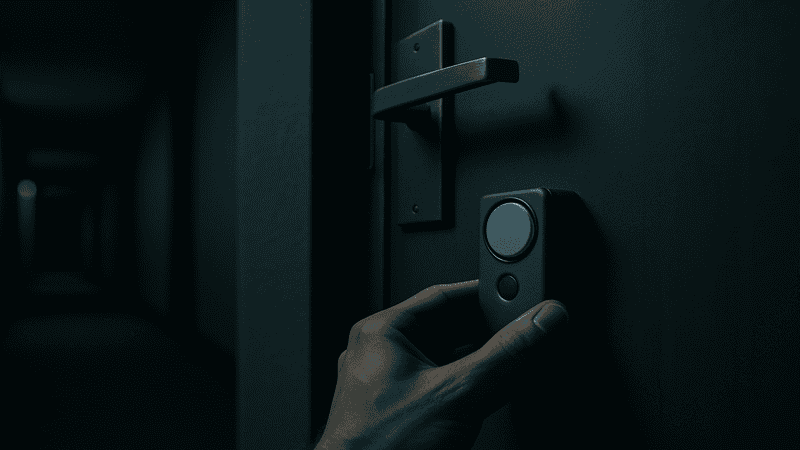
A travel door alarm is a small device — usually pressure or vibration-triggered — that hangs on a hotel door handle or wedges beneath the door to sound a loud alert if someone tries to enter. It doesn’t replace the lock. It tells you something the lock never will: whether someone tested your door while you were asleep, in the shower, or gone for the day. That’s the part most travelers never think about until they learn it the hard way.
What don’t hotel locks tell you?
A hotel deadbolt tells you the door is locked. It doesn’t tell you who tried the handle at 2 a.m. It doesn’t tell you if a keycard from a previous guest still works — which happens more than hotels advertise. It doesn’t tell you if housekeeping, maintenance, or someone posing as either walked past your door and paused a little too long.
I’ve stayed in hundreds of hotels over the years, from roadside motels to high-rise chains. Every lock looks confident. Not every lock is. A travel door alarm doesn’t ask the door to be honest — it just tells you the truth itself, the moment something moves against it.
How does a travel door alarm actually work?
Most models use one of two triggers: pressure against the door itself, or vibration sensed through the frame. You hang or wedge the device near the handle or base of the door, arm it, and it stays silent — until it isn’t. A 120-decibel alarm in a quiet hallway at 3 a.m. gets attention fast, yours and everyone else’s.
The mechanism is simple. What’s not simple is what it exposes. Hotel doors get tested more than guests realize — a soft push here, a slow turn of the handle there. Most of it goes unnoticed because there’s nothing there to notice it. A small travel alarm made for hotel doors changes that equation entirely.
Some travelers pair the alarm with a compact pepper spray they know how to use correctly — not because they expect trouble, but because preparedness rarely announces itself in advance.
Why do experienced travelers use one even in “safe” hotels?
Because “safe” is a feeling, not a fact. A well-lit lobby and a friendly front desk tell you nothing about who has a key to your specific room, or how many people have stayed there since the locks were last rekeyed. I’ve never met a hotel that could answer that question honestly, because most don’t track it closely enough to know.
The travelers who’ve been doing this the longest — the ones who’ve seen a few things — don’t rely on the room’s reputation. They rely on a second layer the hotel doesn’t control. That’s the quiet logic behind carrying something as unassuming as a door alarm built for travel. It’s not about distrust. It’s about not needing to guess.
What should you look for before buying one?
Not every alarm is built the same, and the differences matter more than they appear to on a store shelf.
- Decibel rating: Look for 100dB or higher — loud enough to travel through a hotel door and down a hallway.
- Size and weight: It should disappear into a carry-on side pocket. If it’s bulky, it won’t make the trip with you after the first time.
- Battery type and life: Replaceable batteries you can find at any pharmacy beat proprietary chargers you forgot at home.
- Mounting method: Rubber door wedge, hanging strap, or adhesive — each works differently depending on the door type you’ll face.
- On/off simplicity: After a long travel day, you want to arm it without reading instructions by phone flashlight.
The devices that pass these checks quietly outperform the ones that only look impressive in the packaging.
Is a travel door alarm only useful for hotels?
No — and this is where most people stop thinking about them too soon. The same principle that protects a hotel room applies to a lot of doors that don’t lock the way you’d expect. Renters in older buildings often deal with worn strike plates and secondhand keys nobody accounted for, which is why alarms built for renters and apartments exist as a category of their own.
There’s also a quieter use most people never mention out loud. Families managing a loved one with memory loss use similar alarms to know the moment a door opens at an hour it shouldn’t — a use case covered in depth for door and window alarms for dementia patients. Parents of young children lean on the same technology, detailed in our guide to alarms for kids and toddlers. And for households with a sleepwalker, a specific setup exists too — see door and window alarms for sleepwalkers. The travel alarm in your bag and the alarm on a bedroom door at home are closer cousins than most people assume.
Where exactly should you place it in a hotel room?
Placement changes everything about how well it works, and this is the detail most people skip. The strongest position is low on the door, near the handle or hinge side, where the door’s own movement — not just sound — triggers the sensor. A rubber door-wedge alarm goes underneath the door itself, using the door’s motion against the wedge to set off the sound before the door opens more than an inch.
Skip the window unless it’s ground floor or fire-escape accessible — most hotel rooms above the second floor don’t need it there. Focus your attention on the one entry point that matters: the door someone would actually use.
Frequently Asked Questions About Travel Door Alarms
Do travel door alarms work on all hotel doors?
Most work on standard hinged doors with a small gap at the base or a handle to hang from. Sliding doors and some high-security hotel doors may need a different mounting approach — check the device’s design against your typical travel accommodations before you rely on it exclusively.
Are travel door alarms legal to bring on a plane?
Yes. Travel door alarms contain no restricted components — no blades, no chemicals, no batteries beyond standard consumer limits. They pack in a carry-on without issue, which is part of why frequent travelers keep one in every bag rotation.
How loud is a travel door alarm, really?
Most models range from 100 to 130 decibels — comparable to a smoke detector at close range. It’s designed to be startling on purpose. The goal isn’t a gentle chime. It’s a sound that wakes you instantly and reaches anyone nearby in the hallway.
Can hotel staff or housekeeping disable it?
No. The alarm isn’t connected to the door or hotel systems — it’s a standalone device you control. Staff can’t disarm it, and it won’t interfere with keycard access. It only activates if the door moves while you’ve armed it.
Do I need one if my hotel room already has a deadbolt and chain lock?
A deadbolt only works after someone’s already testing your door. A door alarm tells you the moment that testing happens — while you still have time to react. The two aren’t redundant; one is prevention, the other is awareness.
What’s the difference between a door wedge alarm and a hanging alarm?
A wedge alarm sits under the door and triggers from pressure and movement as the door shifts. A hanging alarm loops over the door handle and triggers if the handle turns or the door swings. Many travelers carry both, since hotel doors vary more than people expect.
Is a travel door alarm worth it for a short one-night stay?
Yes — arguably more so. Short stays often mean unfamiliar layouts, tired travelers, and less attention paid to who’s around. The one night you don’t think you need it is usually indistinguishable from any other night, which is exactly the point.
Can I use a travel door alarm at home too?
Absolutely. Many people start with a travel alarm and later add similar devices throughout the house — for entry doors, kids’ rooms, or aging family members. The underlying mechanism is the same; only the setting changes.
The Part Most Travelers Never Think About Until They Do
A travel door alarm doesn’t make noise for no reason. When it sounds, it’s telling you something true about the moment you’re in — something the hotel’s lock, the front desk, and the hallway camera never quite capture in time. That’s the quiet value of carrying one. It doesn’t ask you to be afraid. It just makes sure you’re never the last to know.
If you’re building out a simple travel security kit, start with a reliable door alarm designed specifically for hotel stays — small enough to forget you’re carrying it, until the one night you’re glad you did.