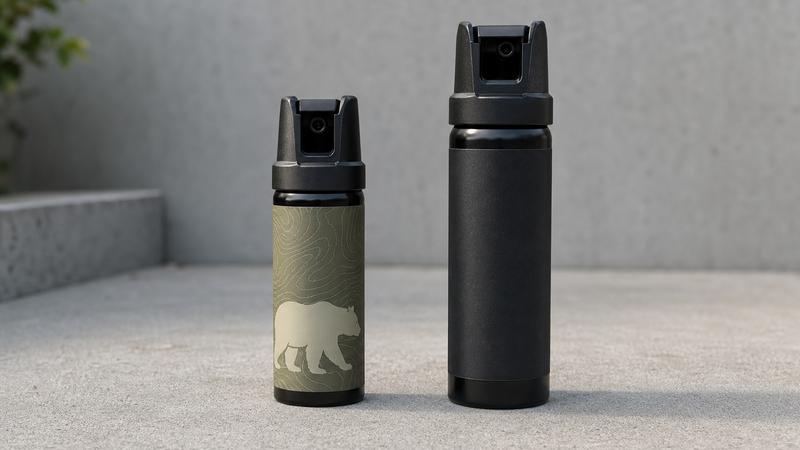
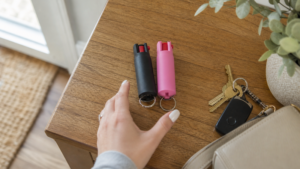
Dog pepper spray can technically affect a human — the active ingredient, oleoresin capsicum, causes the same burning, tearing, and temporary disorientation in people that it does in animals. But “can affect” and “appropriate for self-defense against a human attacker” are two very different things. Dog deterrent sprays are formulated at lower concentrations, designed for a different delivery range, and in most jurisdictions carry different legal classifications than personal defense sprays. Using one as a substitute for proper human-grade pepper spray means accepting a product that wasn’t engineered for that job.
That distinction matters more than most people realize. The self-defense tools you carry say something about how seriously you take your own preparedness. Choosing a spray built for the situation you might actually face isn’t just a practical decision — it’s the only reasonable one.
What is the difference between dog pepper spray and human pepper spray?
The core difference is formulation. Both products use oleoresin capsicum (OC) as their active ingredient, but the concentration and delivery system are calibrated for different targets and different threat scenarios.
Dog deterrent sprays typically run between 0.5% and 1.0% major capsaicinoids — the standardized measure of actual stopping power. Human-grade defense sprays from quality brands like Wildfire, Mace, and Pepper Shot are formulated at significantly higher concentrations, often 1.0% to 2.0% or more major capsaicinoids, with some premium formulations climbing higher. That’s not a minor variance. It’s the difference between an irritant and a reliable incapacitant.
Delivery range is another factor. Dog sprays are often designed for shorter distances — enough to discourage an approaching dog without soaking you in the process. Human defense sprays are engineered with range, pattern, and atmospheric drift in mind. A quality 2 oz pepper spray designed for personal defense gives you meaningful range and a stream or cone pattern optimized for the dynamics of a real encounter with a person — not an animal encounter in a park.
The bottom line: if your concern is a person, carry a product built for that purpose. Dog spray is a tool for one job. Personal defense spray is a different tool for a different job.
Is it legal to use dog pepper spray on a person in self-defense?
This is where things get more complicated, and I’ll be direct: I’m not going to give you legal advice, because self-defense law varies by state, county, and city, and you need to know the laws where you live. What I will tell you is that this question deserves serious consideration before you make any product choice.
In general, self-defense law requires that the force used be appropriate and proportional to the threat. Using a product labeled and marketed as an animal deterrent in a human self-defense situation could create legal ambiguity you don’t want — particularly if there’s any question about whether your response was reasonable. A product designed and labeled for personal human defense has clearer legal standing in that context than one designed to ward off dogs.
Beyond the legal question, many states have specific regulations about the OC concentration, canister size, and formulation of sprays that can legally be carried for personal defense. These regulations were written with human-grade defense products in mind. Dog deterrents often weren’t written into those frameworks at all, which creates its own category of uncertainty.
The smart approach is simple: carry a product specifically designed for human self-defense, know your local laws, and remove the ambiguity entirely.
Will dog pepper spray actually stop a human attacker?
Possibly — but “possibly” is not a standard worth building your personal safety around.
At lower OC concentrations, a dog deterrent spray may cause discomfort, tearing, and some respiratory irritation in a person. Whether that discomfort is enough to stop a determined attacker is a different question. Someone under the influence of drugs or alcohol, or simply motivated enough to push through temporary pain, may not be deterred by a product that wasn’t formulated to incapacitate a human being under stress.
High-quality human defense sprays are engineered to cause immediate, involuntary physiological responses: intense burning of mucous membranes, swelling of capillaries in the eyes causing involuntary closure, and respiratory distress that makes aggressive action extremely difficult. That level of response is the point. It buys you time to move, escape, and get help.
A lower-concentration animal deterrent introduces uncertainty into that equation. And uncertainty in a self-defense situation is something you cannot afford.
If you’re someone who spends time outdoors, makes deliveries, or lives alone in an area where encounters — human or otherwise — are a real concern, the right answer is a properly formulated defense spray. You can read more about purpose-built options for people in exactly those situations at our pepper spray guide for pizza delivery workers — the same principles apply to anyone whose daily routine puts them at elevated exposure.
What concentration of pepper spray is effective for human self-defense?
Not all OC percentages are created equal, and the labeling on many commercial sprays is designed to impress rather than inform. Understanding what you’re actually buying separates a discerning purchaser from someone who grabbed a canister off a shelf because the label looked authoritative.
The two measurements that matter are OC percentage (the percentage of oleoresin capsicum in the formula) and major capsaicinoid percentage (the actual active molecules responsible for the physiological effect). A spray that lists 10% OC sounds potent — and it might be — but a different spray listing 1.2% major capsaicinoids is giving you a more precise, more meaningful number. Major capsaicinoids are what actually cause the incapacitating effect. That’s the number worth paying attention to.
Reputable brands in the human defense category are transparent about these numbers. Brands like Wildfire and Mace are formulated for this specific purpose with documented major capsaicinoid concentrations. Dog deterrent sprays rarely list major capsaicinoid content at all — because that measurement wasn’t part of their design criteria.
If you’re evaluating a larger 4 oz pepper spray for home or vehicle use, the same principle applies. Look for documented major capsaicinoid content, not just OC percentage.
What type of pepper spray should I actually carry for personal defense?
Carry a spray designed, labeled, and legally classified for human self-defense. That’s the short answer. Here’s what that looks like in practice.
For everyday carry, a compact 2 oz pepper spray is the right size — small enough to keep on your person without inconvenience, large enough to give you meaningful deployment capacity. If you live in an apartment building or spend time in enclosed environments, a defense spray suited for apartment use takes range, pattern, and ventilation into account.
Consider a pepper spray with a flip-top safety if you want quick one-handed deployment without the risk of accidental discharge. These designs are common among quality brands and reflect the kind of thoughtful engineering that a dog deterrent simply wasn’t built around.
Think through your specific exposure: when you’re most at risk, where you typically are, and how quickly you’d need to deploy. Then choose accordingly. The right product for someone who walks alone at night in an urban area may be different from what’s right for someone who jogs in a park. Both of them should be carrying a human-grade defense spray — not a dog deterrent.
For a deeper look at how to use what you carry effectively, our post on how to use pepper spray correctly covers six things most people never actually practice — and that most people need to read before they ever need the spray.
Frequently Asked Questions About Dog Pepper Spray and Human Self-Defense
Can dog pepper spray blind a person permanently?
Properly formulated OC sprays — including dog deterrents — cause temporary eye effects: involuntary closure, intense burning, and tearing. These effects are temporary and do not cause permanent blindness in healthy individuals. However, any OC product can cause serious discomfort and should never be used frivolously or in non-defensive situations. Permanent eye damage from OC exposure is not a documented outcome under normal use.
Why do dog sprays have lower OC concentrations than human defense sprays?
Dogs have more sensitive olfactory and mucous membrane systems than humans, so a lower concentration is sufficient to deter them without causing lasting harm. Human defense sprays are formulated at higher concentrations because they need to cause immediate, involuntary incapacitation in a person who may be physically larger, under the influence of substances, or highly motivated to continue threatening behavior. The dosage is calibrated to the target.
Is bear spray stronger than dog pepper spray?
Yes, bear spray is generally formulated at higher OC concentrations than dog deterrents and is designed for use against large, dangerous wildlife. It also deploys at a much greater range and in a wider cloud pattern. Bear spray is not legal to carry for personal human self-defense in most jurisdictions. It serves a specific outdoor emergency purpose and is not a substitute for personal defense spray. For more, see our post on bear spray travel regulations.
What happens if I accidentally spray myself with dog pepper spray?
The effects are similar to accidental exposure to any OC product: burning of the skin, eyes, and mucous membranes, tearing, and respiratory irritation. The lower concentration means the effects may be less intense than a human-grade spray, but the experience is still significantly unpleasant. Our post on how to stop pepper spray burn on skin covers effective decontamination steps.
Are there any states where carrying human pepper spray is restricted?
Yes. Several states regulate the OC concentration, canister size, and buyer age for personal defense sprays. New York, Massachusetts, and California have specific restrictions that differ from most other states. Local ordinances can add additional layers. Always verify current regulations in your specific jurisdiction before purchasing or carrying any defense spray. Laws change, and online summaries are not a substitute for checking current local statutes.
Can I carry pepper spray on an airplane?
Pepper spray — including dog deterrents — is not permitted in carry-on baggage under TSA rules. A single container of up to 4 oz may be packed in checked baggage under specific conditions, but airline and destination country rules vary. Our post on carrying non-lethal self-defense products on an airplane covers this in detail.
What’s the best pepper spray brand for personal defense?
Several quality brands are worth considering. Mace has a long track record with law enforcement and civilian markets. Wildfire is known for high major capsaicinoid content. Pepper Shot offers reliable formulations in practical sizes. Streetwise produces well-regarded personal defense options. The best choice depends on your deployment preference — stream versus cone versus gel — and the size that fits your carry habits. Choose based on documented OC and major capsaicinoid content, not packaging.
How long does pepper spray last after the expiration date?
Most defense sprays carry a two- to four-year expiration date. After that date, the propellant pressure may degrade, reducing spray range and deployment reliability. The OC itself may also lose potency over time. Carrying an expired canister gives you uncertain protection when you need certainty most. Treat expiration dates as real deadlines and replace your spray on schedule.
The tools you carry to protect yourself deserve the same careful selection you’d apply to anything else that matters. Dog pepper spray is a product built for a specific purpose — deterring animals — and it does that job reasonably well. What it isn’t is a precision self-defense instrument calibrated for human threat response. The gap between those two things is exactly the gap between a tool that might work and one that was engineered to work.
Carry what was built for the job you actually need it to do. Browse our selection of personal defense pepper sprays and find the right formulation, size, and delivery system for your situation. You deserve that level of preparation.