A personal alarm only works if you can trigger it in under two seconds, without looking, without fumbling, and without thinking. That means it lives in your hand or on a zipper pull you control — never buried in a bag. The habit that matters most: activate before you need it, not after. Practice the motion daily until it’s automatic, the same way you’d practice drawing a seatbelt across your chest.
How fast do you actually need to activate a personal alarm?
Under two seconds. That’s the standard. Not five. Not “as soon as I can get to it.” Two seconds, because that’s roughly how long it takes for a bad situation to become a worse one. A personal alarm is a tool of interruption — it works by making noise loud enough to draw attention and break an attacker’s confidence. It cannot do that job if it’s zipped inside a purse pocket under your wallet.
I’ve spent years around people who carry protection tools professionally and people who carry them for the first time in their lives. The difference between them isn’t the gear. It’s the habit. A soldier doesn’t check whether his weapon is ready when the moment arrives — he already knows, because he checked before he needed to know. Civilian carry works the same way. You don’t decide how to activate your alarm during the emergency. You decide now, today, before anything happens.
Where should you actually carry a personal alarm for fast access?
On your body, in your dominant hand, or clipped somewhere your thumb reaches without looking. Three positions work. Everything else is a compromise.
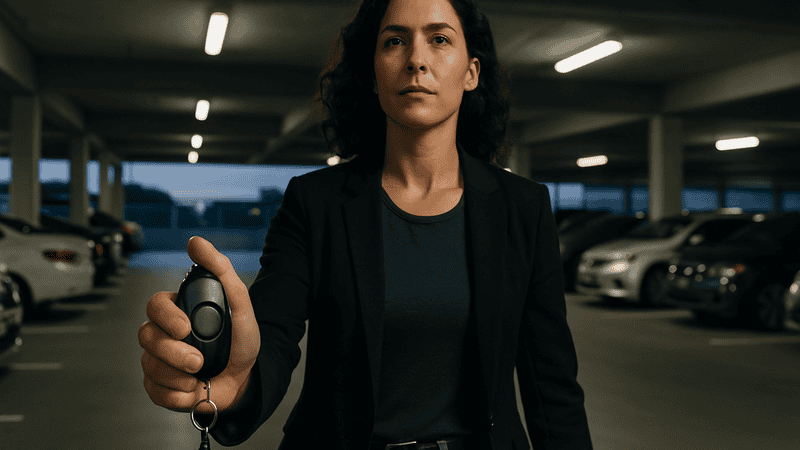
- In-hand carry: The alarm rides in your hand during the specific windows when risk is highest — walking to your car, crossing a parking lot, approaching your front door at night. This is the gold standard. Nothing beats a device already in your grip.
- Keychain carry: Clipped directly to your keys, positioned so your thumb naturally lands on the trigger when you grab them. This works because you already reach for your keys without thinking — you’re just adding one motion to a habit you’ve had for decades.
- Zipper-pull or strap carry: Attached to a bag strap, jacket zipper, or lanyard that sits at chest or hip level. This only works if the alarm is visible and reachable without digging.
What doesn’t work: bottom-of-the-purse carry, glove compartment carry, “I’ll grab it if something happens” carry. Those aren’t carry positions. Those are storage decisions, and storage doesn’t save you in a two-second window.
A stun gun with alarm gives you a dual-purpose command option — audible deterrent and contact protection in one device, carried in a single hand position. That consolidation matters when seconds are the entire equation.
What’s the right grip and hand position before you even need the alarm?
Thumb on the trigger, alarm in a closed fist, arm relaxed at your side. This is the position you take the moment you sense elevated risk — not the moment danger is confirmed. Waiting for confirmation is how people lose the two seconds they needed.
This is a command decision, not a reaction. You are choosing, in advance, to treat certain situations — a dark stairwell, an empty parking structure, a stranger closing distance too fast — as moments that warrant a ready hand. You don’t need proof of danger to justify readiness. You need pattern recognition and the discipline to act on it before you’re certain.
Runners understand this instinct well, which is why personal alarms for runners are built for one-handed activation mid-stride — no stopping, no slowing down, no breaking form to search for a device. The same logic applies whether you’re jogging at 6 a.m. or walking to your car at 9 p.m. Readiness isn’t paranoia. It’s control.
Should you practice activating your alarm before an emergency?
Yes — and most people never do this, which is exactly why they fail when it counts. Practice isn’t optional. It’s the difference between a tool and a decoration.
Take thirty seconds, once a week, and practice the motion: grab, thumb-find, activate. Do it with your eyes closed. Do it while distracted, phone in your other hand, headphones in. Real situations are chaotic and split-second — your practice should reflect that, not a calm kitchen-table test where everything goes right.
Muscle memory is command authority over your own body. When you’ve rehearsed a motion fifty times, your hands know it before your brain has to think about it. That’s the entire goal. You are not trying to remember what to do in a crisis. You are trying to make sure your body already knows, so your mind is free to assess and move.
Does carry habit matter more indoors — like hotels or unfamiliar homes?
Yes, and this is where most people drop their guard completely. You lock the hotel door and assume you’re safe. That assumption is the mistake. Standard hotel locks are not built for forced-entry resistance, and a determined person on the other side of a cheap chain lock has more time than you think.
A hotel door alarm for travel extends your carry habit from your body to your environment. You place it, you arm it, and you get an audible warning if that door moves — giving you seconds you wouldn’t otherwise have. This is the same principle as body carry: control the environment before you need to react to it, not after. If you want a no-fuss setup method, our walkthrough on installing a door alarm without damaging anything covers it start to finish.
Frequent travelers should build this into their arrival routine the same way they check for the nearest exit. It takes ten seconds. It costs nothing in convenience. It buys you command of a space you don’t fully control.
What other everyday-carry tools pair with a personal alarm?
A personal alarm is one layer, not the whole system. Command over your safety comes from layering tools that cover different distances and situations — not relying on a single device to do every job.
Knives for everyday carry serve a different function entirely and require different judgment, training, and legal awareness — but many people carry one alongside an alarm as part of a broader everyday kit. If you’re deciding between carry tools for daily protection, our comparison of rechargeable vs. battery-powered disguised stun guns breaks down reliability differences worth understanding before you commit to one system over another.
Travelers in particular benefit from stacking tools: a personal alarm for travelers in the hand, a door alarm in the hotel room, and a clear habit for both. None of these tools require expertise. They require decision-making done in advance, and hands that already know what to do.
Frequently Asked Questions About Activating a Personal Alarm Fast
How quickly should I be able to activate my personal alarm?
Under two seconds, without looking at the device. If it takes longer, the carry position is wrong — not the device. Reposition it to your hand, your keychain, or a zipper pull at chest height, and practice the motion until it’s automatic.
Is it better to carry a personal alarm in a bag or in my hand?
In your hand, whenever risk feels elevated — walking to a car, entering a stairwell, approaching an unfamiliar building at night. A bag is fine for low-risk moments, but the alarm should come out and into your grip the moment your situation changes.
Can I attach a personal alarm to my keys?
Yes, and it’s one of the most effective carry methods available. Clip it so your thumb naturally lands on the trigger when you grab your keys — a motion you already perform dozens of times a week without thinking.
Do personal alarms work as well as pepper spray?
They serve a different purpose. An alarm creates noise and draws attention, which can interrupt an attacker’s confidence and alert people nearby. Spray creates physical distance. Many people carry both. If you’re weighing options for active use, our post on running with pepper spray covers what runners specifically need to know.
How loud does a personal alarm need to be to be effective?
Most reliable personal alarms sit around 120–130 decibels — loud enough to be heard through walls and across parking lots. Anything significantly quieter won’t reliably draw attention in an outdoor or high-noise environment.
Should I test my personal alarm regularly?
Yes. Test the sound output and battery function monthly, and practice the physical activation motion weekly. A device with a dead battery or a grip you haven’t rehearsed is not a device you can count on.
What’s the biggest mistake people make with personal alarm carry?
Storing it instead of carrying it. Bottom-of-the-bag, glove compartment, “I’ll grab it if something happens” — none of these count as carry. If you can’t reach it in two seconds without looking, it isn’t doing its job.
Can a stun gun with a built-in alarm replace carrying two separate devices?
For many people, yes. A stun gun with alarm combines an audible deterrent with contact-level protection in a single carry position, which simplifies the two-second activation habit instead of forcing a choice between two devices in the moment.
Command the Moment Before It Arrives
Preparedness isn’t a feeling. It’s a decision you make ahead of time, rehearsed until your hands don’t need your brain’s permission to act. A personal alarm carried correctly — in your grip, on your keys, at your chest — puts you in control of a moment most people never plan for.
I don’t want you to need it. But if you do, I want your hand already there. Take a look at our full lineup of personal alarms and pair them with a carry habit that actually holds up under pressure.