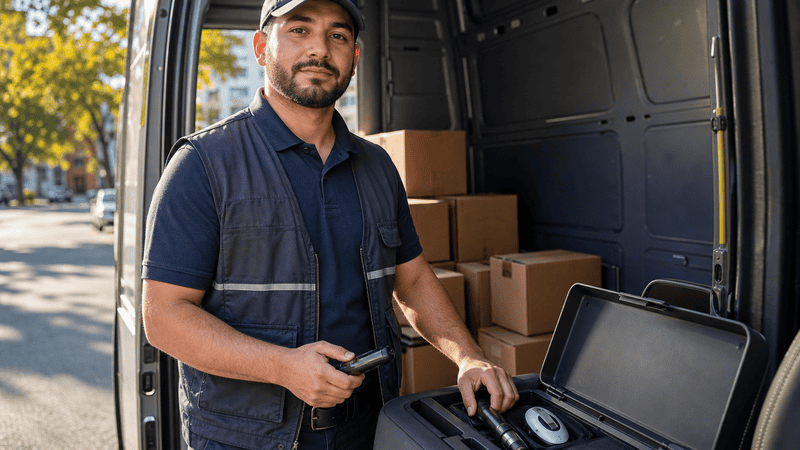
A compact delivery driver safety kit needs five things: a reliable non-lethal defense tool, a loud personal alarm, a flashlight, a basic first aid kit, and a way to document incidents. Everything should fit in a glovebox or door pocket — bulk defeats the purpose. The driver who builds this kit controls the moment before trouble starts, not after.
Why does a delivery driver need a safety kit at all?
Because you’re alone, you’re moving, and you’re predictable. Every stop is scheduled. Every route is repeatable. Anyone watching knows where you’ll be and when. That’s not a reason to be afraid — it’s a reason to be prepared. I spent years learning that preparation isn’t about expecting the worst. It’s about refusing to be caught without options.
Delivery work puts you in unfamiliar driveways, dim parking lots, and buildings you’ve never entered before. You control none of that environment. What you control is what’s in your vehicle and what’s on your person. A safety kit isn’t extra weight you carry out of worry. It’s the difference between reacting and responding.
What should go in a compact delivery driver safety kit?
Five categories cover it. No more, no less. Anything beyond this becomes clutter you won’t maintain and won’t reach for when it matters.
- A non-lethal defense tool. Compact, dependable, and rated for real use — not a novelty. A slim option like the Streetwise or ZAP line fits a door pocket without adding bulk.
- A personal alarm. Loud enough to draw attention fast. A 130dB unit clipped to a keyring or bag strap works in half a second.
- A flashlight with strobe function. Disorients at close range and doubles as a tool for checking dark porches, gates, and stairwells.
- A basic first aid kit. Small cuts, dog bites, minor injuries — you handle these yourself more often than you’d think.
- A dash cam or phone mount for quick documentation. Evidence matters. A clear angle on your vehicle and the door you’re approaching protects you after the fact.
Every item on this list earns its space by being useful in seconds, not minutes. That’s the standard. If it takes longer than three seconds to access, it doesn’t belong in the front of the kit.
How do I choose a stun gun that actually fits a delivery kit?
Size and grip matter more than voltage numbers. A stun device that’s too bulky ends up buried under seats or left at home — useless. Look for something slim enough to sit in a cupholder or center console without rattling around, with a safety switch you can operate one-handed.
The Runt is built exactly for this — small enough to disappear into a glovebox, strong enough to do its job. The Pulse 2 offers a similar footprint with a slightly different grip style, worth comparing if hand size is a factor. Either way, test the switch before you need it. Familiarity is what makes a tool fast under pressure.
Don’t overthink the model. Overthink the placement. A device in the trunk does nothing. A device within arm’s reach of the driver’s seat does everything.
Where in the vehicle should safety items be placed?
Reachable without looking. That’s the rule. Your eyes stay on the door, the porch, the person walking toward you — not digging through a bag.
- Driver’s door pocket: personal alarm and flashlight. First things grabbed exiting the vehicle.
- Center console: compact stun device, positioned for a quick draw with the dominant hand.
- Glovebox: first aid kit and any backup items you don’t need instantly.
- Dash or windshield mount: camera angled to capture the walkway to each delivery point.
This layout isn’t guesswork. It’s built around how fast a hand can move under stress. Practice reaching for each item with your eyes forward, like you would mid-delivery. If you fumble in practice, you’ll fumble for real. Fix it now.
How often should I check or restock my safety kit?
Monthly, at minimum. Batteries drain. First aid supplies get used and not replaced. A stun device left uncharged for months won’t perform when you need it most.
Set a recurring reminder tied to something you already do — an oil change, a paycheck cycle, the first of the month. Check the charge on your defense device, test your alarm’s battery, and glance at your first aid stock. This takes five minutes and it’s the five minutes that keeps the whole kit functional instead of decorative.
What else should I know before building my kit?
A kit is only as good as the habits behind it. Situational awareness comes first — no device replaces the instinct to notice a situation before it escalates. Awareness is still your first line of defense, and every tool in this kit exists to back that awareness up, not substitute for it.
Carry habits matter as much as the gear itself. A personal alarm buried in a bag is worthless. Knowing how to activate an alarm in seconds is what makes the difference between a tool and a paperweight. Build the habit before you need the result.
If you want the full breakdown of driver-specific gear beyond what fits in a glovebox, our guide on the six self-defense tools every delivery driver should carry goes deeper into route-specific recommendations.
Frequently Asked Questions About Delivery Driver Safety Kits
What’s the most important item in a delivery driver safety kit?
A reliable personal alarm. It requires no aim, no strength, and works instantly. Sound draws attention faster than almost any other response, and attention is what changes the outcome in most confrontations before they escalate further.
Can I keep a stun gun in my car legally as a delivery driver?
Laws vary by state and by employer policy. Check your state’s regulations and your company’s vehicle policy before carrying one on the job. This post doesn’t substitute for legal advice specific to your location.
How much does a good compact safety kit cost to build?
A functional kit — alarm, flashlight, compact defense device, first aid basics — typically runs under $100 total. The investment is small compared to the control it gives you over an unpredictable moment.
Do I need a dash cam if I already have a phone?
A dedicated dash cam records automatically and doesn’t rely on you remembering to hit record under stress. A phone works as a backup, but automation is the advantage a mounted camera gives you.
Where should I store my stun gun for the fastest access while driving?
The center console, positioned for a one-handed draw with your dominant hand. Avoid the glovebox for this item — it’s too far and too slow to open compared to a console you already reach past constantly.
How do I know if a stun device is too bulky for a delivery vehicle?
If it doesn’t sit flat in a cupholder or door pocket without shifting, it’s too bulky. Compact models built for concealment and quick draw, like the Runt or Pulse 2, are sized specifically for vehicle use.
Should I tell my employer I carry a safety kit in my vehicle?
Check your company’s policy first. Some employers restrict certain items in company vehicles. Personal vehicles used for delivery work typically fall under your own discretion, but confirm before assuming.
What’s the biggest mistake drivers make when building a safety kit?
Overpacking. A kit with ten items scattered across the vehicle takes too long to use. Five well-placed essentials, checked monthly, will always outperform a disorganized pile of gear you forget how to access.
A safety kit doesn’t make the job risk-free. Nothing does. What it does is put control back in your hands — the ability to respond fast, document clearly, and drive away from a bad situation instead of into one. Build it once, check it monthly, and you’ll stop thinking about it until the day you need it. That’s exactly how it should work.