For most people carrying an expandable baton, the right length sits somewhere between 16 and 21 inches when fully extended — but that range tells only half the story. The length that actually works depends on your height, your grip strength, the environment you’re moving through, and how fast you need to deploy it. Get that combination right, and the baton becomes a reliable tool. Get it wrong, and it works against you.
Most buyers focus on the wrong question. They ask, “How long should it be?” when the real question is: “What am I actually going to do with it, and where?” The answer to that second question changes everything. I’ve seen people buy the longest baton on the shelf thinking more reach means more safety. Sometimes that’s true. Sometimes it’s the opposite. What you don’t know about baton length is worth understanding before you spend a dollar.
What do the different expandable baton lengths actually mean for self-defense?
Expandable batons — also called telescopic or collapsible batons — typically come in three general size categories: compact (around 16 inches extended), mid-size (around 21 inches), and full-size (26 inches and above). Each one was designed with a different user and a different context in mind. Understanding those differences is the part most product descriptions leave out.
A 16-inch baton is designed for close-range deployment in tight spaces. It collapses small — often under 7 inches — which makes it easy to carry on a belt, in a bag, or in a glove compartment. It’s fast to deploy and manageable for users with smaller hands or less upper body strength. The tradeoff is reach. At 16 inches extended, you’re working in close. That requires more confidence and composure in a confrontation.
A 21-inch baton gives you meaningful reach without becoming unwieldy. It’s the length most commonly associated with personal protection carry. For most adults of average height — roughly 5’4″ to 5’10” — this is the range where balance and reach work together naturally. It’s also the sweet spot for vehicle carry, which is why a purpose-designed telescopic baton for car use often lands in this range.
A 26-inch baton is closer to what law enforcement uses in crowd control scenarios. For the average civilian, it’s often too long to deploy quickly in a panic, too heavy to swing accurately when your hands are shaking, and too large to carry discreetly. There are situations where it makes sense. Most everyday self-defense scenarios aren’t those situations.
Does your height determine what baton length you should carry?
Height matters more than most people realize — not because taller people need longer batons, but because the physics of swinging a rigid object change with your reach. A shorter person using a 26-inch baton is fighting the tool as much as the threat. A taller person using a 16-inch baton is giving away reach they don’t need to sacrifice.
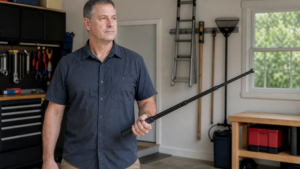
A rough working guideline: when held at your side in a ready grip, the extended baton should reach roughly to your hip or just above. That puts the striking arc in a natural zone for your arm mechanics. If the baton extends past your hip significantly, you’ll need a wider swing to generate force — and wider swings take longer and give more warning to the person you’re trying to stop.
For users under 5’4″, a 16-inch compact is often the more controlled choice. For users between 5’4″ and 5’11”, a 21-inch baton tends to feel balanced and responsive. For taller individuals, the 21-inch still works well in most situations, with a 26-inch becoming worth considering only if distance management is a deliberate part of their personal safety plan.
How does the environment change what baton length makes sense?
This is the piece almost nobody talks about — and it might be the most important variable of all. Where you are when something goes wrong shapes what length actually helps you.
Indoors — a parking garage, a hallway, a convenience store, your own home — the physics of a long baton work against you. You lose swing arc. You may not have clearance to extend the baton fully. In those environments, a compact 16-inch baton, fully extended, is often more practical than a 26-inch one. It deploys fast, moves in tight quarters, and doesn’t require the space a longer baton demands.
Outdoors — a walking trail, a parking lot, an open street — longer reach becomes a genuine advantage. A 21-inch baton gives you distance between yourself and a threat. Combined with situational awareness, that distance is time. Time is what you actually need in a confrontation — not force.
Vehicle carry deserves its own note. Storing a baton in a car means you need a collapsed length that fits where you can actually reach it quickly. A baton stuffed under the seat that takes ten seconds to find is not a self-defense tool — it’s stored metal. Purpose-built options like a baton designed specifically for vehicle carry account for collapsed size and quick-access positioning. That detail matters more than the extended length in many vehicle scenarios.
How does collapsed size affect how useful an expandable baton really is?
There’s a hidden equation in every expandable baton purchase: extended length is what protects you, but collapsed length is what determines whether you actually have it with you when something happens.
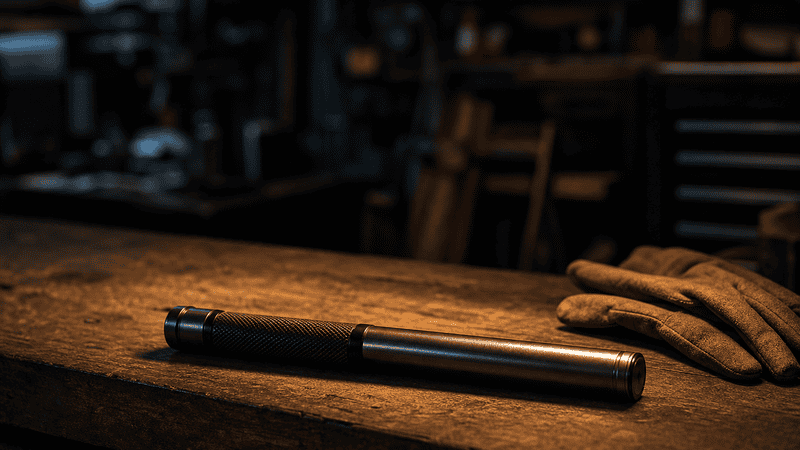
A 26-inch baton typically collapses to around 10–11 inches. That’s a significant carry commitment — it won’t sit invisibly on a belt or drop unobtrusively into most bags. A 21-inch baton collapses to roughly 8–9 inches. A 16-inch compact can collapse to under 7 inches, sometimes closer to 6.
The baton that’s with you beats the baton that’s the right length but left at home. That’s not a philosophical point — it’s operational logic. A compact collapsible baton that you carry consistently provides more protection than a full-size model you find inconvenient to bring. The collapsed size question answers itself when you’re honest about your daily carry habits.
If you want the holster option — a dedicated carry system that keeps the baton accessible without requiring a bag — look at purpose-paired options like a telescopic baton with holster. Having a carry system designed for the baton removes the friction that causes people to leave it behind.
What factors should a first-time buyer actually weigh when choosing baton length?
Most first-time buyers don’t know what they don’t know. They default to the biggest option thinking more is better. That instinct is understandable. It’s also frequently wrong. Here’s what actually deserves your attention:
Grip and wrist strength. A longer, heavier baton requires more wrist control to deploy accurately under stress. If you have limited grip strength — whether from age, injury, or size — a 21-inch is often more controllable than a 26-inch when your hands are shaking.
Training and practice. An expandable baton is a skill-based tool. Length doesn’t compensate for unfamiliarity. Practice deploying the one you own — the snap motion, the ready stance, the one-hand hold. A shorter baton you’ve practiced with is worth more than a longer one you’ve never extended outside the packaging.
Legal considerations in your state. Baton laws vary by state and sometimes by city. This isn’t legal advice — but knowing your local regulations before you carry anything matters. Research that on your own or consult local authorities. The responsibility for lawful carry is yours.
What you’re pairing it with. A baton is one layer of a personal safety approach — not the whole system. Many people pair a baton with other non-lethal tools. If you want to understand how deterrence works beyond physical tools, it’s worth reading about how a stun gun can be used as a deterrent without making contact — because layered preparedness almost always outperforms single-tool reliance.
Is a longer expandable baton always more effective for self-defense?
No — and this is the assumption that causes the most confusion. Longer reach is only an advantage when you have the space, the strength, and the composure to use it. In confined spaces, under extreme stress, with no training, a shorter baton you can deploy instantly often outperforms a longer one you fumble with.
Force is generated by the speed of the strike and the density of the tip — not just by the length of the shaft. A well-placed strike with a 16-inch baton is more effective than a poorly executed swing with a 26-inch one. The tool is only as effective as the person using it. Length is one variable. It’s not the most important one.
What matters most is the combination: a length suited to your body and environment, a collapsed size you’ll actually carry, and enough familiarity with deployment that the baton doesn’t become a liability when the moment comes.
Frequently Asked Questions About Expandable Baton Length for Self-Defense
What is the most common expandable baton length for civilian self-defense?
The 21-inch extended length is the most common choice for civilian personal protection. It balances reach and maneuverability for most adult body types, collapses to a manageable carry size, and performs well across both indoor and outdoor environments. For most people with no law enforcement or military background, 21 inches is the length that works without requiring significant training to control effectively.
Is a 16-inch baton too short to be effective for self-defense?
No. A 16-inch collapsible baton is effective in close-range situations and confined environments. It deploys quickly, collapses small enough for consistent daily carry, and is well-suited for users with smaller frames or limited grip strength. Its limitation is reach — at 16 inches, you’re working in close quarters. In many real self-defense scenarios, that’s exactly where encounters happen anyway.
What is the best expandable baton length to keep in a car?
For vehicle carry, a 16- to 21-inch extended length — with a collapsed size under 9 inches — tends to work best. The collapsed dimension matters as much as the extended length in a vehicle, because accessible positioning is critical. A baton you can’t reach and deploy in seconds is not useful in a car confrontation. Look for options specifically designed with vehicle access in mind.
Does my height affect what baton length I should choose?
Yes, in practical terms. Users under 5’4″ generally find 16-inch batons easier to swing accurately and control under stress. Users between 5’4″ and 5’11” typically work well with 21-inch models. Taller users may consider 26-inch batons only if they have adequate space for wider swing arcs and are comfortable managing a heavier, larger tool during high-stress situations.
Are 26-inch expandable batons legal to carry for civilians?
Baton legality varies significantly by state and locality. Some states restrict expandable batons entirely; others allow carry with or without a permit. A 26-inch baton may also face additional scrutiny in jurisdictions that regulate impact weapons. Research your state and local laws before purchasing or carrying any baton. This site does not provide legal advice — confirming lawful carry is your responsibility.
How does collapsed length affect everyday carry for an expandable baton?
Collapsed length determines whether you’ll actually have the baton with you when you need it. A 26-inch baton collapses to around 10–11 inches — too large for pocket carry and conspicuous on a belt. A 16-inch compact collapses to under 7 inches, fitting easily in a bag or on a belt without drawing attention. The best baton is the one you carry consistently, regardless of its extended length.
Do I need training to use an expandable baton effectively?
Yes. A baton is a skill-based tool. Effective deployment — especially the snap-open motion and one-hand grip under stress — requires practice before you need it. Length alone does not make a baton effective. Someone who has practiced consistently with a 16-inch baton will typically outperform an untrained person using a 26-inch one. Practice deployment, know your carry position, and build the muscle memory before the moment arrives.
What should I look for in an expandable baton holster?
Look for a holster that matches your specific baton’s collapsed diameter and length, allows single-hand draw, and positions the baton where your hand naturally falls. Nylon and reinforced polymer holsters hold up better than soft fabric over time. A holster that requires two hands to draw from, or that shifts during movement, is a liability in a real scenario. The carry system should disappear into your routine — not require attention to manage.
There’s something quietly important about knowing what you carry and why. Most people who buy a baton buy the wrong length for the wrong reasons — guessing big, assuming bigger means safer, never considering the environment they’ll actually be in or the body doing the carrying. The right length isn’t a number on a shelf. It’s the answer to a set of questions most buyers don’t think to ask.
Take the time to ask them. Browse the compact collapsible baton options and the full-size models with holsters — not to buy on impulse, but to see which variables actually apply to your life. The right baton is the one that fits your body, your environment, and your carry habits. I don’t want you to need it. But if you do, I want you to have the one that actually works.