
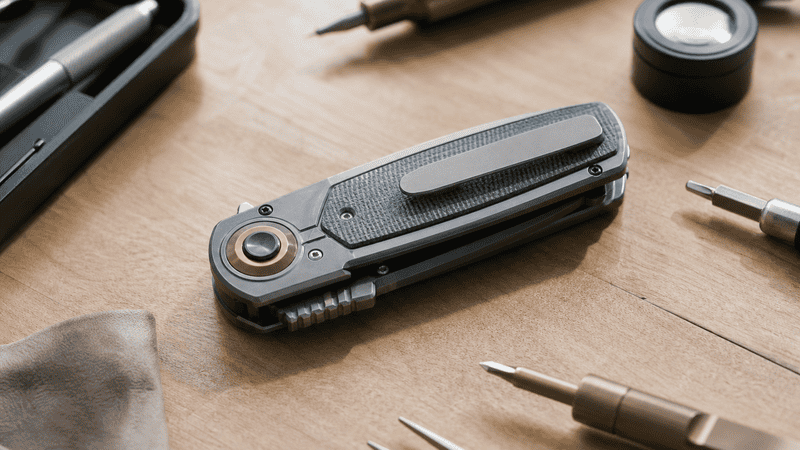

Automatic knives deploy using a spring-loaded mechanism connected to a button or lever on the handle. Pressing the release disengages a small internal catch, letting a compressed spring drive the blade open in a fraction of a second. There’s no motor, no battery, and no hidden electronics — it’s a mechanical system that’s been refined for over a century, not a modern gadget.
Most people assume automatic knife deployment involves something electronic. It doesn’t. That assumption is worth challenging right away, because it changes how you think about these tools entirely. There’s no circuit board hiding in the handle. There’s no motor spinning a gear. What’s actually happening inside an automatic knife is a piece of mechanical engineering that predates the smartphone by decades — and understanding it tells you a lot about why these knives are built the way they are.
I spent years around gear that had to work the first time, every time, with no room for malfunction. That’s the standard automatic knives are built to. Once you understand the mechanism, you stop seeing it as a mystery gadget and start seeing it as what it is: a simple, reliable spring system that’s been engineered to do one job well. Let’s open it up.
What actually happens inside an automatic knife when you press the button?
Pressing the button releases a spring-loaded catch that was holding the blade closed under tension. The moment that catch disengages, the compressed spring pushes the blade along a pivot track until it locks into the open position. The entire sequence takes a fraction of a second, and it’s the spring doing the work — not the button, and not any kind of motor.
Think of it like a mousetrap. The spring is loaded and held back by a small mechanical latch. The button’s only job is to move that latch out of the way. Everything after that is stored energy releasing itself along a controlled path. It’s the same principle used in umbrella deployment or in certain seatbelt pretensioners — a small trigger action releasing a much larger stored force.
What makes automatic knife design interesting is how much precision goes into that “controlled path.” The pivot, the track, the lock point — all of it has to be machined tightly enough that the blade doesn’t wobble, doesn’t overshoot, and locks solidly every time. That’s where cheap versions fail and well-built ones don’t.
How is this different from an assisted opening knife?
An assisted opening knife requires you to manually start the blade moving before the spring takes over. An automatic knife needs no manual start at all — the button alone triggers full deployment. This is the core mechanical distinction, and it’s often misunderstood even by people who’ve owned both types.
With an assisted knife, you flick the blade partway open with your thumb, and a spring finishes the job. You’re providing the initial energy. With an automatic, the spring is already fully loaded and waiting. The button is purely a release mechanism — you provide none of the opening force yourself.
This distinction matters practically. Automatic deployment is faster and requires less hand strength, which is exactly why it was originally developed for people who needed one-handed operation under difficult conditions — linemen, pilots, and later, tradespeople who needed a tool that opened reliably with gloves on or with one hand occupied.
Why does the spring design matter so much?
The spring is the entire mechanism — its quality determines whether the knife opens the same way on day one and day one thousand. A weak or poorly tempered spring loses tension over time, which means slower deployment, incomplete locking, or eventual failure. This is the single biggest difference between a knife that’s built to last and one that isn’t.
Good automatic knives use torsion springs or coil springs made from tempered steel alloys designed to resist fatigue. That word — fatigue — is the real enemy of any spring mechanism. Every time a spring compresses and releases, it experiences microscopic wear. Engineering around that wear, so the spring holds its force through thousands of cycles, is where the real innovation in this space happens.
It’s a small detail most buyers never think about, but it’s the difference between a tool that performs consistently for years and one that starts feeling “off” after a few months. If you’re comparing options for everyday carry knives, spring quality is worth asking about directly — it matters more than blade steel for most people’s daily use.
What’s the difference between side-opening and out-the-front (OTF) mechanisms?
Side-opening automatics swing the blade out from the handle on a pivot, the same motion as a traditional folding knife but spring-driven. Out-the-front (OTF) knives push the blade straight out through the front of the handle along a linear track. Both use stored spring energy, but the mechanical path the blade travels is completely different.
Side-opening designs are mechanically simpler — one pivot point, one spring, one lock. That simplicity tends to make them more durable over the long run, since there are fewer moving parts to wear out or misalign.
OTF designs are more complex. They typically use a slider or a double-action mechanism that both retracts and deploys the blade along a linear channel. That complexity allows for a genuinely different carry profile and deployment feel, but it also means tighter tolerances are required to keep the blade from wobbling side to side in the track. This is a case where more moving parts means more that has to be engineered correctly — not more that’s likely to go wrong, if it’s built right.
Why did this mechanism take so long to become mainstream?
Automatic knife mechanisms have existed since at least the late 1800s, but manufacturing precision limited quality and consistency for most of that history. It’s only in the last few decades that CNC machining made tight, repeatable tolerances affordable at scale — which is why the automatic knives available today are dramatically more reliable than what existed even twenty years ago.
Early automatic knives were often handmade, which meant enormous variation in quality. A catch might be slightly too loose, causing accidental deployment. A spring might be slightly mismatched to the pivot geometry, causing binding. These were real problems, and they’re part of why automatic knives developed a reputation — fair or not — for being less dependable than fixed blades.
Modern manufacturing solved most of that. Precision-cut internal components, consistent spring tempering, and better lock geometry mean today’s automatics perform far more predictably. That shift — from handcraft to precision manufacturing — is the real innovation story here, more than any single design gimmick.
What should I actually look for in a well-built automatic knife?
Look for a solid, audible lock-up with no blade play, a button that requires deliberate pressure rather than a hair-trigger touch, and consistent deployment speed across multiple tests. These three things tell you almost everything about the internal engineering without needing to take the knife apart.
Blade play — any wobble side to side or up and down when the blade is locked open — is the clearest sign of a loose pivot or worn lock. A knife that feels tight and solid when open has been machined to proper tolerances. A button that’s too easy to press is a safety concern, not a feature; a well-designed mechanism requires intentional pressure to release.
If you’re evaluating knives specifically for self-defense use, deployment consistency matters more than speed alone. A knife that opens instantly nine times out of ten and hesitates on the tenth isn’t one you want to depend on. Test it. Open it a dozen times in a row and pay attention to whether it feels the same every time.
Frequently Asked Questions About How Automatic Knives Work
Do automatic knives use batteries or electronics?
No. Automatic knives are entirely mechanical. They rely on a compressed spring held in place by a small internal catch. Pressing the button releases the catch, and the spring’s stored energy drives the blade open. There is no motor, no battery, and no electronic component anywhere in the mechanism.
What’s the difference between an automatic knife and a switchblade?
“Switchblade” is an older, more general term that’s often used interchangeably with “automatic knife.” Both describe knives that deploy via spring tension when a button or lever is pressed, rather than requiring manual opening. There’s no meaningful mechanical difference — it’s mostly a difference in terminology and era.
Can the spring in an automatic knife wear out over time?
Yes, though quality springs made from tempered steel alloys are designed to resist this for thousands of open-close cycles. Fatigue is gradual — you’ll typically notice slower deployment or a slightly weaker lock before total failure. Regular light cleaning and avoiding excessive dry-firing of the mechanism helps extend spring life significantly.
Why do some automatic knives feel more solid than others?
Solidity comes down to manufacturing tolerances. A knife with a tightly machined pivot, a well-fitted lock, and a properly tempered spring will feel tight and consistent when open, with no wobble. Cheaper knives often cut corners on these tolerances, which shows up as blade play or inconsistent deployment speed.
Is out-the-front (OTF) deployment more reliable than side-opening?
Not inherently — reliability depends on build quality, not deployment style. Side-opening mechanisms are mechanically simpler, which can mean fewer failure points. OTF mechanisms are more complex but, when properly engineered, deploy just as consistently. The deciding factor is manufacturing precision, not which category the knife falls into.
How often should I clean or maintain the mechanism?
A light cleaning every few months is generally enough for regular carry use — more often if the knife is exposed to dust, sand, or moisture. Compressed air or a small brush around the pivot area, followed by a drop of light lubricant, keeps the internal catch and spring moving freely without buildup interfering with deployment speed.
Are automatic knives harder to maintain than manual folding knives?
Not significantly. The internal mechanism is sealed and self-contained, so maintenance mostly involves keeping the pivot area clean and lightly lubricated, the same as any folding knife. The main difference is you’re maintaining a spring-and-catch system rather than just a pivot — but it doesn’t require special tools or expertise.
What’s the biggest myth about how automatic knives work?
The biggest myth is that some kind of hidden mechanical trick or “gimmick” makes them open so fast. In reality, it’s simple physics — a compressed spring releasing stored energy the instant a small catch is moved out of the way. The speed comes from spring tension, not from anything exotic in the design.
Understanding the mechanism behind automatic deployment strips away the mystery and replaces it with something more useful: informed judgment. Once you know what makes one automatic knife reliable and another one flimsy, you’re no longer guessing at the counter — you’re evaluating spring quality, lock tolerance, and build precision like someone who actually knows what’s inside the handle. If you want to see how that engineering translates into everyday carry options, take a look at our everyday carry knife selection or browse knives built specifically with personal defense in mind. Either way, you’ll be choosing with the mechanism in mind — not the marketing.