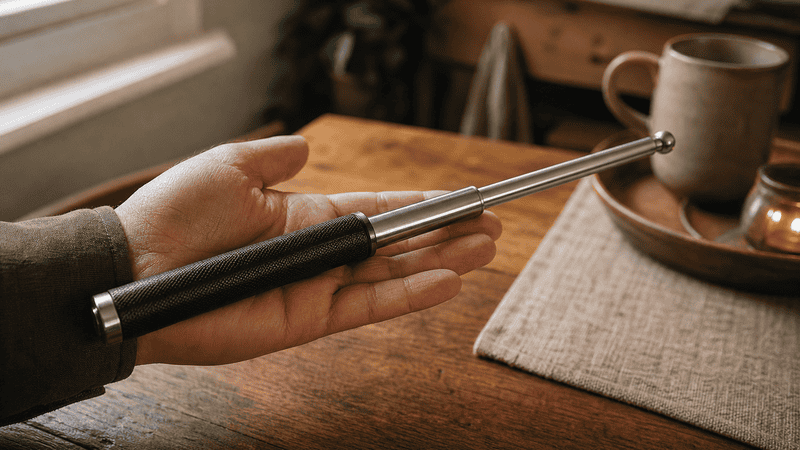
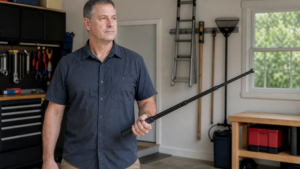
Expandable batons are most commonly made from hardened carbon steel or aircraft-grade aluminum, with some models using reinforced polymer composites for their outer shafts or grip sections. The material determines everything — weight, impact strength, corrosion resistance, and how the baton holds up over years of use. These aren’t decoration. They’re tools built to perform under pressure, and the material is where that performance either lives or dies.
I’ve held a lot of tools in my time — in the field, at home, and in the years since I came back to civilian life. There’s something I’ve come to understand about the things we carry close: the best ones feel honest in your hand. A well-made expandable baton carries that same honesty. You can feel what it’s made of. You can sense the intention behind it. And when you understand the materials, you start to understand what you’re really holding — and why it matters.
Why does the material of an expandable baton matter for self-defense?
Material isn’t a technical detail you can skip over. It’s the difference between a tool that holds up and one that folds when it counts. For anyone carrying an expandable baton for personal protection — whether you’re a parent walking to your car at night, a college student navigating an unfamiliar city, or a senior citizen who wants something solid within reach — knowing what your baton is made of tells you exactly how much you can rely on it.
Carbon steel batons are the workhorses of the category. They’re dense, hard, and built to absorb and deliver force without deforming. A steel baton dropped on concrete, used hard, or left in a hot car won’t lose its structural integrity. The tradeoff is weight — steel batons run heavier, and over the course of a long carry day, that adds up. But for many people, that weight is part of the reassurance. It’s real. It’s solid. It’s there.
Aircraft-grade aluminum tells a different story. It’s lighter, often significantly so, and in a well-engineered baton, it delivers comparable strength to steel for the kinds of impacts you’re likely to encounter in a self-defense situation. Aluminum also resists corrosion naturally, which matters if you carry in humid climates or keep a baton in your vehicle through changing seasons. The tradeoff is that under extreme, repeated stress, aluminum can fatigue faster than steel. For most everyday carriers, this is never an issue. But it’s worth knowing.
Polymer or composite sections show up most often in grip areas, tip caps, or lightweight training versions. A full polymer baton designed for actual use is rare among quality brands — the material simply can’t match steel or aluminum for structural load-bearing. When you see polymer, pay attention to where it’s being used and why.
What is the difference between a steel and aluminum expandable baton?
This is the comparison most buyers end up wrestling with, and it deserves a straight answer. Steel is heavier and harder. Aluminum is lighter and almost as strong for practical self-defense purposes. Neither is universally better — the right choice depends on what you need the baton to do and how you plan to carry it.
A carbon steel baton in the 16- to 21-inch range typically weighs somewhere between 12 and 20 ounces fully extended, depending on shaft diameter and tip design. That weight is meaningful. If your plan is to keep it in a telescopic baton for your car or a desk drawer at work, weight matters less. If you’re clipping it to your belt every morning for a long shift on your feet, you’ll feel every ounce.
An aircraft-grade aluminum baton in the same size range might weigh half as much. For someone who carries daily — a nurse walking to a parking garage at 2 a.m., a college student crossing campus after a late class — that difference is real and it’s felt. And a good aluminum baton, properly heat-treated and engineered, will handle the stress of a real self-defense use without issue.
The honest answer is this: if you’re choosing between two quality batons and one is steel, one is aluminum, and both are built by a reputable manufacturer — choose the one you’ll actually carry. The best baton in the world does nothing sitting in your glove box because it felt too heavy to bring inside.
How does baton construction affect how it opens and locks in place?
The material inside the shaft determines more than weight and durability — it controls how cleanly and reliably a baton deploys. A baton that hesitates when you need it fast is a baton that fails you at the worst possible moment. This is something I feel strongly about. Gear that doesn’t work is worse than no gear, because it creates false confidence.
High-quality batons use precision-machined steel or aluminum shafts that nest inside each other with tight tolerances. When you flick the wrist, the shafts extend smoothly and lock with a solid, audible click. That click matters. It tells you — without looking — that the baton is fully deployed. If you’ve ever opened a well-made compact collapsible baton and felt that snap into place, you know exactly what I mean.
Cheaper batons — often made from lower-grade steel or thin-walled aluminum tubing — don’t machine to the same tolerances. The shafts wobble slightly when extended. The lock feels soft. Under real impact, that slop in the connection can cause the baton to collapse or rotate in your grip. That’s not a small problem. It’s a fundamental failure of the tool’s purpose.
Look for batons that specify aircraft-grade aluminum or hardened carbon steel in their product descriptions. Look for solid ball-bearing tips at the strike end — these are also typically steel, and their density adds to impact mass without adding much overall weight. These construction details aren’t marketing language. They’re engineering decisions that determine whether your baton works the way it should.
Does the material affect how legal an expandable baton is to carry?
Material itself doesn’t determine legality — but it can affect how a baton is classified in some jurisdictions. Most states regulate expandable batons based on their mechanical design and intended use, not their specific material composition. That said, baton laws vary significantly by state, and some municipalities add local restrictions on top of state law.
Before you carry any expandable baton — steel, aluminum, or otherwise — take a few minutes to look up your state and local laws. I’m not going to give you legal advice. That’s not my place and it’s not something I’m qualified to do. What I’ll tell you is this: know before you carry. Not knowing isn’t a defense. And carrying something you’re not legally permitted to carry turns a tool for protection into a legal liability.
If you’re unsure where to start, our post on how long an expandable baton should be for self-defense covers size considerations alongside the legal landscape in more detail. It’s worth reading before you decide what to buy.
What should you look for in a quality expandable baton?
You’re not just buying a product. You’re making a decision that could matter on the worst day of your life. That’s not fear-mongering — that’s just honest. And because it’s honest, I want you to walk into that decision with clear eyes and specific criteria.
Start with material transparency. Any baton worth buying will tell you clearly what it’s made from. If the product description is vague — “durable metal alloy” without specifics — that’s a signal. Quality manufacturers stand behind their materials because their materials are worth standing behind.
Check the tip. A solid steel ball tip adds striking mass and protects the extended shaft from bending under force. Check the handle — rubberized or textured grips on aluminum or steel handles matter in a real situation when your hands might be sweating or cold. Check the locking mechanism. A good baton opens with authority and closes only when you intentionally close it.
If you carry in a vehicle, consider a model that comes ready to store — our telescopic baton with holster pairs the baton with a proper carry solution so it’s always accessible and never rattling loose under your seat. Details like that reflect how seriously a product was thought through.
Size matters too — and if you haven’t thought through the right length for your build and intended use, I’d encourage you to read more about choosing the right expandable baton length before you commit to a purchase.
Frequently Asked Questions About Expandable Baton Materials
What are most expandable batons made from?
Most quality expandable batons are made from hardened carbon steel or aircraft-grade aluminum. Steel offers maximum density and durability at the cost of added weight. Aluminum provides nearly comparable strength at a significantly lighter carry weight. Both materials are appropriate for self-defense use when the baton is properly engineered and manufactured to tight tolerances.
Is a steel or aluminum expandable baton better?
Neither is universally better — it depends on how and where you plan to carry. Steel is denser and harder, making it ideal for stationary storage like a vehicle or desk. Aluminum is lighter and more comfortable for daily carry. For most everyday users, an aircraft-grade aluminum baton from a quality manufacturer will perform well in any realistic self-defense scenario without the weight penalty of steel.
Are polymer or plastic expandable batons safe for self-defense?
Full polymer batons are generally not recommended for real self-defense use. Polymer doesn’t have the structural strength of steel or aluminum under impact stress, and cheap polymer construction can lead to shaft collapse or deformation during use. Polymer components are acceptable in grip sections or training versions, but the load-bearing shafts of a defensive baton should be metal.
What is the tip of an expandable baton made of?
Quality expandable batons typically feature a solid hardened steel ball tip at the strike end. The steel tip adds impact mass, protects the end of the shaft from bending under force, and delivers force more efficiently on contact. Some batons use rubber or polymer tips, which are more appropriate for training scenarios than real-world defensive use.
Does the material of an expandable baton affect how it locks open?
Yes, significantly. The locking mechanism depends on how precisely the nested shafts are machined. High-quality steel and aluminum batons are machined to tight tolerances, producing a firm, audible lock when deployed. Lower-grade materials with looser tolerances result in wobble in the extended position, which can compromise both grip and structural integrity during impact. A solid lock is a quality indicator worth paying attention to.
Will an expandable baton rust?
Steel batons can develop surface rust if exposed to moisture over time, particularly in humid climates or when stored in a vehicle without a protective case or holster. Aircraft-grade aluminum naturally resists corrosion. If you carry a steel baton, periodic light oiling and a quality holster go a long way toward preserving it. Aluminum batons generally require less maintenance in wet or humid environments.
How heavy is a typical expandable baton?
Weight varies by material and size. A hardened steel baton in the 21-inch range typically weighs between 15 and 20 ounces. An aircraft-grade aluminum baton in the same length may weigh 8 to 12 ounces. Compact models designed for everyday carry run lighter still. If daily carry weight is a concern, an aluminum baton or a shorter compact model will be easier to manage without sacrificing meaningful protection.
Can I keep an expandable baton in my car?
Many people do keep an expandable baton in their vehicle as part of a layered personal protection approach. A model specifically sized and mounted for vehicle access makes that more practical — our telescopic baton for car is designed with that use in mind. Always verify your state and local laws before carrying a baton in your vehicle, as regulations vary and vehicle carry laws can differ from on-person carry laws.
There’s something quietly meaningful about taking care of yourself and the people around you. Not out of fear — out of respect for what life can throw at you without warning. A quality expandable baton, made from honest materials, engineered to perform, and chosen with real thought — that’s not a weapon. It’s a responsibility you carry lightly because you hope you never need it.
That’s why I do this. Not to sell you something. To make sure that if a moment ever comes, you’re not reaching for nothing. Browse what we carry at Stun Guns and find what fits your life, your carry style, and your peace of mind.